You’ve booked the tee times, checked the airline baggage policies, and already dreamed of that first drive on a sun-soaked fairway. Then reality hits: your current golf bag is a flimsy tube of fabric that offers zero protection, and you’re about to trust it to baggage handlers who see luggage as a contact sport. Frequent flying with clubs is stressful, especially when you’re trying to balance cost, durability, and weight. The solution isn’t just any travel bag—it’s finding the best value golf bags for frequent flights that offer hard-shell protection or reinforced soft-sided security without breaking the bank.
This guide cuts through the marketing noise. We’ll break down exactly what features matter for air travel, which materials actually withstand the abuse, and how to choose a bag that fits both your clubs and your budget. Whether you’re a weekend warrior flying twice a year or a golf professional logging 40 flights annually, you need a bag that protects your investment—and your game. Let’s dive into the nitty-gritty of travel bag construction, airline regulations, and smart buying strategies.
What Makes a Golf Bag “Travel-Ready” for Airline Use?
A travel-ready golf bag is specifically engineered to withstand the rigors of commercial airline handling. It typically features reinforced padding, durable exterior materials, and protective elements like neck braces or hard-shell tops to prevent damage during transit.
Not all bags marketed as “travel” bags are created equal. A standard Sunday bag or a lightweight stand bag will get crushed, torn, or bent in the cargo hold. Travel-specific bags, however, are built with a different philosophy: they prioritize protection over convenience. These bags use materials like high-denier nylon, ballistic polyester, or hard ABS plastic shells. They also include internal straps to secure the club head, a padded base to absorb impact, and reinforced wheels for easy maneuvering through terminals.
Key Protection Zones on a Travel Bag
Consider the three most vulnerable areas of any golf bag during flight: the top, the middle, and the bottom. The top needs a rigid structure to prevent the club heads from being crushed. The middle needs sufficient padding to absorb side impacts. The bottom needs a hard base to withstand drops onto the tarmac. A good travel bag addresses all three zones specifically, not just with generic padding but with structural reinforcement.
Understanding the Weight Penalty
Most airlines have a 50-pound weight limit for checked baggage. The bag itself contributes to this weight. A heavy hard-shell case might weigh 18 pounds, leaving only 32 pounds for your clubs and accessories. A lightweight soft case might weigh 7 pounds, giving you 43 pounds of capacity. You must balance durability with the weight penalty. For frequent flyers, every pound counts, especially if you’re already close to the limit with your shoes, rain gear, and range finder.
Internal Straps and Club Head Protection
Internal compression straps are non-negotiable. They prevent the club heads from banging against each other during transit. Some bags feature a “lift” system that raises the club head area, keeping it off the bottom of the case. Look for bags with a padded top or a built-in “head cover” that adds an extra layer of protection. This internal organization is what separates a dependable travel bag from a glorified sack.
Why Should Frequent Flyers Prioritize a Hard-Shell Over a Soft-Shell Design?
Frequent flyers should prioritize hard-shell designs when they own expensive clubs or travel more than 10 times per year. Hard-shell cases provide rigid, structural protection that soft bags cannot match, effectively deflecting impacts rather than transmitting them. They are the gold standard for airline travel.
However, the choice isn’t always black and white. Soft-shell bags have improved significantly, incorporating high-density foam and reinforced frames. The decision hinges on your risk tolerance, the value of your clubs, and your willingness to haul around a bulky case. Let’s compare the two styles in the context of real-world airline travel.
Pros and Cons of Hard-Shell Cases
- Pros: Maximum protection, rigid top, stackable, crush-proof, excellent for fragile graphite shafts.
- Cons: Heavy (usually 15-20 lbs), bulky to store at home, difficult to fit in small car trunks, often exceeds carry-on size restrictions.
Pros and Cons of Soft-Shell Bags
- Pros: Lightweight (5-10 lbs), easier to store, flexible for fitting into tight spaces, often cheaper, can double as a stand bag.
- Cons: Less impact resistance, vulnerable to drops on the top, requires proper packing with towels for added protection, the bag itself can get scuffed or torn.
The “Hybrid” Compromise
For frequent flyers who want a middle ground, hybrid bags combine a soft body with a hard top. This is a clever design that protects the most vulnerable part—the club heads—while keeping the overall weight down. Many of these . are designed with a skeleton frame that maintains shape and offers some crush resistance. This type of bag is often the practical choice for those who value protection but don’t want the burden of a full hard case.
Why the “Best” Bag for You Depends on Your Club Value
If you play with a set of $1,500 irons and a $500 driver, the extra weight and bulk of a hard case are justified. If you travel with a basic starter set, a robust soft bag with a solid top might be all you need. Insurance and repair costs should factor into your decision. Replacing a single shaft can cost $100-$300, quickly making a cheap bag a costly mistake, Before heading to the airport, make sure your swing mechanics are dialed in by practicing with training aids learn how to improve golf accuracy using simple training tools so you arrive at your destination ready to play your best.
How Do Airline Policies Influence Your Choice of Golf Bag?
Airline policies dictate the size, weight, and number of bags you can check. Most major US carriers treat a golf bag as one standard checked piece, but they often have specific size limits (usually under 80 linear inches) and enforce strict 50-pound weight penalties. Understanding these rules is crucial before you purchase a bag.
Oversized bags trigger additional fees. If your hard-shell case exceeds the airline’s maximum dimension, you’ll be charged an oversized luggage fee of $100 to $200 each way. This can turn a “budget” bag into an expensive ordeal. Therefore, measuring your bag’s dimensions (including wheels and handles) is essential.
Actual Airline Size and Weight Limits
Here’s a sample of typical airline policies (as of 2025):
| Airline | Max Weight | Max Linear Dimensions | Oversized Fee |
|---|---|---|---|
| American Airlines | 50 lbs | 126 inches | $150 |
| Delta Air Lines | 50 lbs | 115 inches | $200 |
| United Airlines | 50 lbs | 115 inches | $200 |
| Southwest Airlines | 50 lbs | 80 inches | $125 |
Note: Linear dimensions are length + width + height. Most golf bags, even large hard cases, fit within the size limits but are right at the edge of the weight limit. Always travel with a portable luggage scale.
The “Club Glove” Effect: How Bag Design Affects Fees
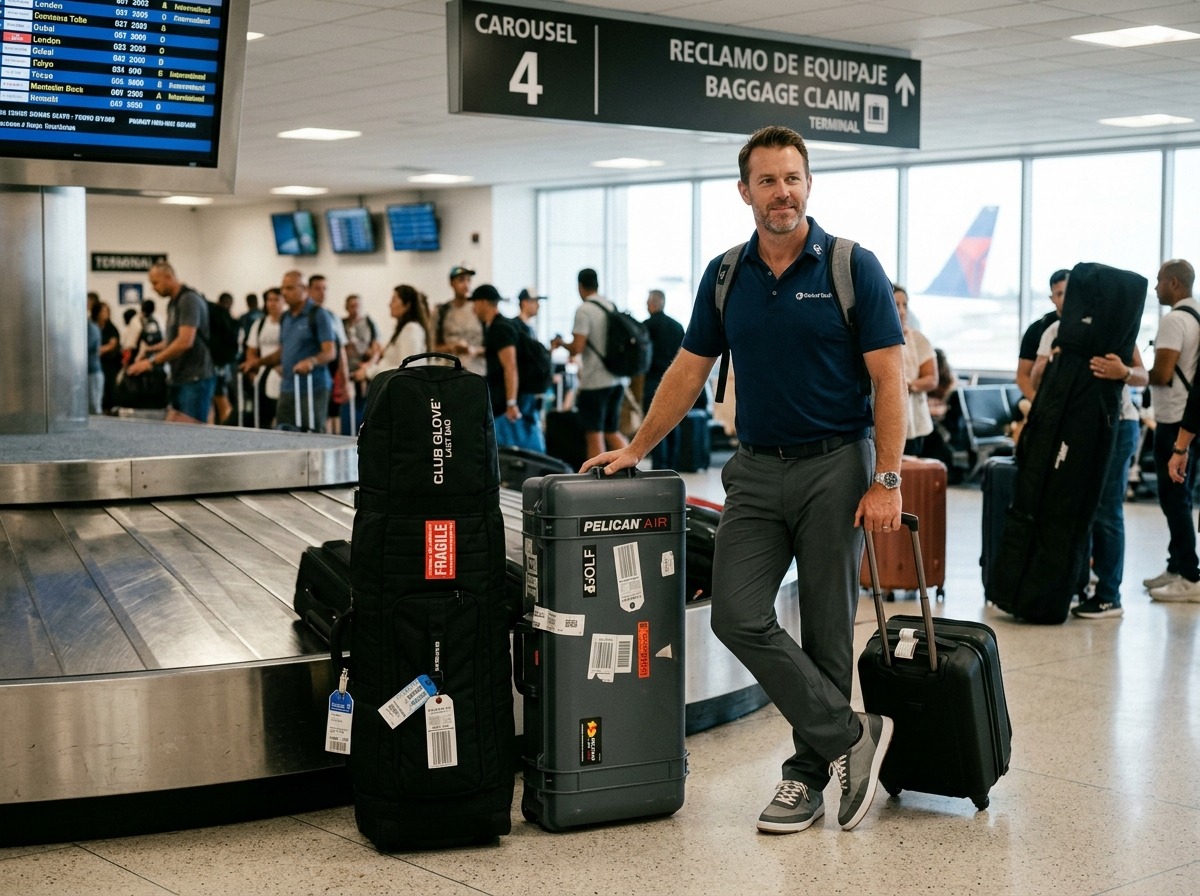
Certain bag brands, like Club Glove, are known for their oversized designs that push the limits of airline acceptance. This is intentional to provide maximum clearance for the clubs. However, it also means you might be flagged for size checks. Choosing a bag that is specifically marketed as “airline compliant” helps avoid unexpected fees. Brands like Sun Mountain and Titleist offer bags designed to meet mainstream airline size restrictions.
Can You Use a Soft Bag Without Insurance?
Flying without additional insurance is risky. Even with a good bag, damage can occur. Credit cards often provide baggage insurance, but it has limits. For frequent flyers, it’s wise to look into third-party insurance like Golf Bag Insurance or add a rider to your homeowner’s policy. The cost of the bag is an investment, but so is protecting the contents.
Which Materials Offer the Best Durability-to-Weight Ratio?
The best durability-to-weight ratio comes from 1680D ballistic nylon or high-density polyester with a rubberized coating. These materials resist abrasion, are waterproof, and are lighter than hard plastic or metal frames. The key is the weave and the coating.
Cheaper bags use 600D or 840D nylon, which is lighter but offers less tear resistance. For serious travel, you want a heavier denier count. Additionally, look for a reinforced frame that uses plastic or aluminum supports inside the padding. This provides structure without adding excessive weight.
Comparing Common Bag Fabrics
- 840D Nylon: Lightweight, good for occasional travel, less abrasion resistant.
- 1680D Ballistic Polyester: Highly durable, resists punctures, water-resistant, heavier than nylon.
- TPU Coated Nylon: Excellent waterproofing, tough, but can become stiff in cold weather.
- ABS Hard Plastic: Maximum rigidity, heavy, vulnerable to cracking under extreme impact.
The Role of Wheels and Handles
Frequent flyers need robust inline skate wheels with a metal bearing system. These wheels are smooth-rolling and can handle rough terrain like parking lots. The handle should be a comfortable telescoping grip that locks into place. Look for bags with multiple handles for lifting in tight spaces. A bag with a split handle design is easier to grab when going up stairs.
Zipper Quality: The Hidden Weak Point
Zippers are the first point of failure on soft bags. Look for #10 or #12 gauge zippers with a locking mechanism. A broken zipper can render your bag unusable and expose your clubs to the elements. Reinforced stitching around the zipper track is also crucial. Test the zipper’s smoothness and durability before purchasing.
What Are the Top Features to Look For in a Travel Bag Under $200?
Under $200, you can find a very functional soft-shell travel bag with a rigid top and good wheels. The key is to look for specific features that mimic high-end models: a molded top, a padded divider system, and a strong base plate.
You won’t find a true hard-shell case for under $200 without sacrificing quality, but you can find excellent soft bags that work brilliantly. The best value is a bag that weighs under 8 pounds, uses durable fabric, and includes a stiff internal frame to protect the top. Here’s what to check:
Essential Features Checklist
- Molded Top: A plastic or EVA foam top that holds its shape, preventing crushing.
- Reinforced Base: A plastic or rubber base to protect the bottom skid plate.
- Internal Straps: At least one top strap to secure the club head area, and one middle strap.
- Wheels: Inline skate wheels with a solid mount.
- Lockable Zippers: Rings to attach a TSA-approved lock.
Popular Budget-Friendly Models
Some popular options in this price range include the Izzo Golf Deluxe Travel Bag, the Ogio Monster (during sales), and the Wilson travel bags. Each offers a balance of protection and weight. Read reviews on Amazon for “drop tests” and “airline durability” from frequent travelers. The Sun Mountain Kube is a unique option that folds flat but offers a hard case feel.
Avoiding Common Budget Bag Pitfalls
Beware of bags with thin, flimsy padding that feels like “craft foam.” Look for thick, closed-cell foam. Also, check if the internal straps are firmly anchored to the bag’s frame. If they pull out easily, they will fail during transit. Finally, test the telescoping handle. It should feel sturdy, not wobbly.
How Should You Pack Your Golf Bag to Minimize Damage Risk?
Packing your bag correctly is just as important as the bag itself. You can have the best-value golf bags for frequent flights, but if you pack poorly, you still risk damage. The goal is to ensure the club heads do not move, and the bag retains its shape.
First, place a towel rolled up around the club heads. This cushions them and prevents rattling. Second, use a headcover on your driver and woods. Third, put the heavier clubs (wedges, irons) at the bottom of the bag and the woods on top to maintain balance. This prevents the bag from tipping over in the cargo hold.
Step-by-Step Packing Guide
- Place a towel over the club heads and secure with a rubber band.
- Put your shoes in a separate compartment or at the bottom of the bag, upside down.
- Wrap the shafts with a sweatshirt or towel for additional padding.
- Secure the internal straps tightly to compress the clubs.
- Lock the zippers and attach a TSA-approved lock.
Using Extra Clothing as Padding
Do not pack fragile items like glass bottles or electronics. Use jeans, jumpers, and towels to fill gaps between the clubs and the bag’s walls. This acts as a shock absorber and saves space in your suitcase. For frequent flyers, this method effectively turns your golf bag into a second suitcase.
The “Reverse” Packing Method
Some professionals invert the clubs so the handles are at the bottom of the bag. This places the heavier metal club heads at the base, lowering the center of gravity and preventing the bag from toppling over. However, you must ensure the top of the bag has enough padding for the handles. This method is more advanced but offers superior protection.
Is a Travel Bag Worth the Investment Compared to Rental Clubs?
Yes, a travel bag is worth the investment if you fly more than twice a year with your own clubs. Rental sets cost $50-$100 per round, lack your specific shaft and grip specifications, and often have inferior club quality. Owning a travel bag preserves your game.
Consider the cost: five rental sets at $75 each equals $375, which is the price of a high-end travel bag or three budget-friendly ones. Over a few years, the savings are significant. Furthermore, using your own clubs ensures consistency, which is vital for maintaining your handicap.
Comparing the Costs
- Rental Fee per Trip (avg 3 rounds): $150 – $200
- Travel Bag Cost (good quality): $150 – $400 (one-time)
- Airline Fees: $0 – $100 per flight depending on airline and status.
If you travel twice a year, the bag pays for itself in less than two seasons. Plus, you have the convenience of having your own gear ready at the destination.
Saving on Airline Baggage Fees
To avoid airline fees, consider getting a credit card that offers free checked bags, like the Delta SkyMiles or United Explorer cards. These often include your golf bag for free. Some travel insurance policies also reimburse baggage fees. The goal is to factor these potential savings into your bag selection budget.
The Convenience Factor
Traveling with your own clubs means you can practice at your destination, warm up before a round, and check your equipment specs. This intangible benefit often outweighs the cost savings. You already know the feel of your clubs, so why play with unknown rentals?
How to Maintain Your Travel Bag for Longevity
Rinse your travel bag with fresh water after every trip to remove salt and dirt from the wheels and zippers. Lubricate the zippers with a silicone spray and check for loose screws on the wheels. Replace worn wheels before they break mid-trip. Simple maintenance doubles the bag’s lifespan.
Store the bag in a dry place. If it’s a soft bag, consider storing it with a towel inside to help maintain its shape. Avoid storing it in direct sunlight, as UV rays degrade the fabric. For hard cases, wipe down the interior to prevent mildew.
Cleaning and Repairing
Use mild soap and a soft brush to clean the fabric. For the wheels, use a compressed air can to blow out debris. If a zipper pull breaks, replace it immediately. Most major bag brands sell replacement parts. Inspect the stitching around the handle and straps after each flight.
When to Replace Your Travel Bag
If the internal stiffeners start to bend easily or the fabric tears, it’s time for a replacement. A bag whose wheels are falling off is a liability. Frequent flyers should expect to replace a soft bag every 3-5 years, depending on flight frequency. A hard case can last 10+ years but may crack after severe impacts.
Frequently Asked Questions
What is the lightest durable golf travel bag?
The lightest durable options are made with 1680D nylon and weigh around 5.5 lbs. The Titleist Players 4 or Sun Mountain Kube are excellent choices, but they sacrifice some padding for weight reduction. You’ll need to pack with extra care when using featherweight bags.
Can I fit my pushcart in a travel bag?
No, standard golf travel bags are designed for a carry bag and its contents. A pushcart requires a separate travel case specifically sized for a trolley. Trying to force a pushcart into a standard travel bag can damage the bag and the wheels of the cart.
Is a hard-shell golf case worth the extra cost?
Yes, for frequent flyers (10+ trips/year) or those with high-value clubs, a hard case is worth it. Cases like the SKB Deluxe or Pelican offer near-impenetrable protection. They are heavier and harder to store, but the peace of mind is unmatched.
How do I clean a golf travel bag?
Use a vacuum to remove dust and dirt. For the exterior, use a gentle all-purpose cleaner and a soft cloth. For stubborn scuffs on the wheels, use a stiff brush. Always air-dry thoroughly after cleaning to prevent mold.
Are travel bags TSA approved?
Travel bags themselves don’t require TSA approval, but they must be checked. You should use a TSA-approved lock for the zippers so agents can inspect without breaking your lock. TSA-approved locks are identifiable by the red diamond logo.
Can I use a backpack-style golf bag for air travel?
Yes, but you must put it inside a travel cover. A backpack bag alone offers zero protection. You’ll need a soft travel cover that fits over the backpack-style bag, but many of these bags have unusual dimensions that don’t fit standard covers. It’s better to use a conventional stand bag with a dedicated travel case.
Should I buy a bag with or without wheels?
Always buy with wheels. For frequent flyers, non-wheeled bags are impractical. Inline skate wheels are a must-have for moving through long airport terminals. If you frequently travel to courses with gravel paths, choose larger, all-terrain wheels.
Conclusion
Choosing the best value golf bags for frequent flights is about balancing weight, protection, and cost. You don’t need the most expensive bag on the market if you pack smart and understand the basic construction. Focus on durable fabrics, a rigid top, solid wheels, and a padded interior. For the majority of frequent travelers, a high-quality soft-shell bag with a hard top provides the perfect compromise.
Remember to verify your airline’s specific bag size and weight policies before every trip. A few minutes of careful packing—using towels and garments—can save you expensive repair bills. And if you’re flying more than a few times a year, investing in a reliable travel bag is not an expense; it’s a savings plan for your equipment and your game.
Your next step is to measure your current golf bag and compare its dimensions with the airlines you use most. Then, set a budget and target a bag that meets the critical features outlined above. Don’t wait until the night before your flight to buy a cheap, flimsy sack. Your clubs deserve better, and so does your scorecard. Safe travels and happy golfing!