Florida is brutal on inflatable paddleboards. A single afternoon on the Intracoastal can leave a board looking faded, gritty, and older than it is — UV radiation breaks down PVC, salt crystals chew through seams, and sand works its way into every valve and crevice. If you own an Anti-Slip EVA Deck SUP or any inflatable model, the good news is that most sun, salt, and sand damage is preventable with a simple routine.
Quick Answer
Protect your inflatable SUP by rinsing it with fresh water after every saltwater session, drying it completely before deflating, storing it out of direct sun (ideally indoors or in a shaded, ventilated space), and applying a UV protectant designed for PVC. Sand damage is mainly a storage and valve problem, not a paddling problem — keep the board off the beach when not in use, and rinse valves before opening them.
Key Takeaways
- UV exposure is the single biggest long-term threat to inflatable SUPs in Florida; consistent shade and UV protectant matter more than any other habit.
- Always rinse with fresh water before drying and packing — salt left on seams and valves causes corrosion and stiffens PVC over time.
- Dry the board fully before deflating and rolling; trapped moisture and sand inside the roll cause mildew and abrasion.
- Store inflatable SUPs slightly inflated in a cool, shaded space rather than fully deflated in a hot garage or car trunk.
- Sand is abrasive to EVA deck padding and valves; rinse those areas first and never open a valve with grit around the seal.
Why Florida Is Harder on Inflatable SUPs Than Most Places
Florida combines three stressors that rarely appear together at the same intensity elsewhere: year-round high UV index, warm saltwater, and fine, abrasive sand. UV radiation degrades the plasticizers in PVC and the adhesive in seams. Saltwater accelerates oxidation on metal components like valve springs and D-rings. Sand gets into everything — deck padding, valve threads, and the seams between the drop-stitch core and outer shell.
A board used in, say, the Pacific Northwest might see mild UV and freshwater for most of the year. A Florida board can be exposed to intense sun eight to ten months out of twelve. That means your maintenance schedule should be tighter than the generic advice you’ll find on most manufacturer pages — think “rinse every session” rather than “rinse weekly.”
The Daily Routine: What to Do After Every Paddle
Most long-term damage happens in the first twenty minutes after you get off the water. A five-minute post-paddle routine prevents the slow damage that shows up a year later.
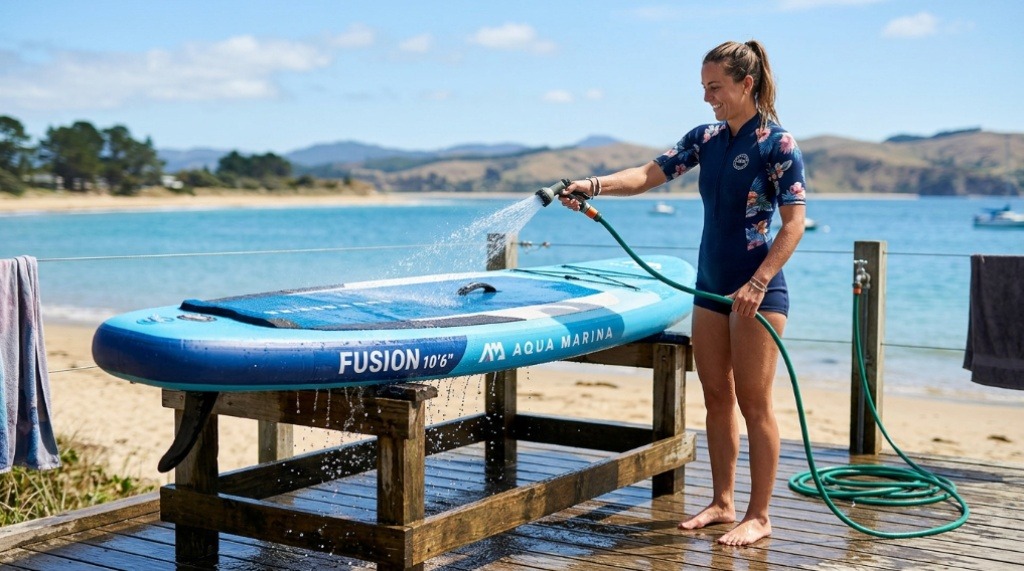
- Rinse with fresh water before anything dries. Saltwater evaporates and leaves salt crystals that act like fine sandpaper against seams. A quick freshwater rinse from a hose or even a couple of gallons from a jug is enough for a day trip.
- Pay extra attention to the valve and EVA deck. Sand tends to sit in the grooves of the anti-slip EVA deck padding and around the valve threads. Flush both areas specifically rather than just hosing the whole board.
- Wipe down, then air-dry in shade. Don’t leave a wet board in direct sun to dry — that’s the fastest way to fade graphics and stress seams. Shade drying takes longer but is far gentler.
- Deflate only after the board is fully dry. Rolling a damp board traps moisture against the PVC, which can lead to mildew smell and seam adhesive degradation.
- Roll loosely, don’t fold tight. Sharp folds stress the same points on every storage cycle. A loose roll with a strap is better for seam longevity than a tight, compact bundle.
UV Protection: Your Board’s Biggest Long-Term Threat
Sun damage on inflatable SUPs is cumulative. A board that looks fine after one summer in Florida often shows chalky, faded, or stiff PVC by the second or third. You can’t fully stop UV exposure, but you can slow it dramatically, Before heading out on the water, you might also want to read our detailed breakdown on portability is a lightweight inflatable paddle board easy to carry?
Practical UV strategies that actually work
- Use a UV protectant made for PVC or hypalon. Products marketed for inflatable boats, RIBs, and paddleboards are appropriate; automotive vinyl protectants are a reasonable substitute but check they’re safe for PVC. Avoid silicone-based products that can make the deck slippery.
- Don’t leave the board inflated on a rack or beach all day. If you’re taking a lunch break, move the board into shade or deflate it and put it under cover.
- Choose a board bag with UV-blocking material for storage and transport. Even a light-colored, opaque bag makes a measurable difference over years of use.
- Store indoors when possible. A garage is better than a dock box; an air-conditioned closet is better than a garage. Heat accelerates the same degradation UV causes.
The EVA deck is especially vulnerable because it sits on top of the board, fully exposed. Faded, cracking EVA foam is often the first sign that a board has spent too much time in the Florida sun.
Sand: The Quiet Abrasive
Sand damage is rarely obvious in the moment. It shows up later as worn deck padding, a sticky valve, or a slow leak from a seam. The three entry points that matter most are the valve, the EVA deck seams, and the seam between the drop-stitch core and outer shell.
- Never set the board down directly on sand when inflated. Use a towel, a mat, or set it on grass. Fine Florida sand, especially coquina, is abrasive against PVC and EVA foam.
- Rinse the valve area before opening it. Sand caught in the valve threads will grind when you screw the cap on, eventually causing a slow leak.
- Vacuum or shake out the storage bag periodically. Sand that lives in the bottom of your bag will abrade the board every time you pack it.
- Avoid dragging the board across the beach. Even short drags scuff the bottom and stress the rail seams.
Saltwater Rinsing: How Thorough Is Enough?
Rinsing is not about making the board look clean — it’s about removing chloride ions that corrode metal parts and stiffen PVC over time. A thorough rinse means the board is actually free of salt residue, not just wet.
For a day trip, a quick hose-down is usually fine. For a board that lives in saltwater all summer, a more thorough rinse every week or two matters: fill a bucket with fresh water, use a soft brush on the EVA deck and around the valve, and let the board sit in shade until fully dry. Pay attention to the D-rings, the fin box (if your inflatable has a removable fin), and the seams near the nose and tail.
If you’re paddling in freshwater springs or lakes, you can stretch the rinse frequency — but Florida is surrounded by salt, so odds are you’ll be rinsing often.
Storage That Actually Extends Board Life
How you store your board between sessions has more impact on longevity than almost anything else you do.
Deflated or inflated?
Both approaches work, but they serve different situations.
- Storing inflated is better for the board. Slight inflation (around 5–8 PSI) keeps the drop-stitch core from being folded onto itself and reduces stress on the seams. This is the best option if you have a cool, shaded space with room.
- Storing deflated is practical for small spaces and travel. Roll loosely, keep the board clean and fully dry, and use a breathable bag rather than a sealed one to prevent trapped moisture.
- Avoid long-term storage in a hot car or attic. Heat is a bigger enemy of PVC adhesive than cold. Florida garages routinely hit 120°F in summer, which is hard on seams.
Where to store
Indoors, out of direct sunlight, with reasonable airflow. Hanging vertically on a padded rack is fine as long as the rack doesn’t put pressure on a single seam. Never store a rolled board under heavy objects; compression can create permanent creases.
Common Mistakes That Shorten Board Life in Florida
- Leaving the board inflated on a car roof rack in the sun between sessions.
- Rolling the board up wet after a humid morning session.
- Opening the valve with sand around the seal.
- Using a generic car wax or silicone spray on the deck, which makes EVA dangerously slippery.
- Storing the board in a black, sealed bag in direct sun — the bag becomes an oven.
- Ignoring small seam bubbles or a slow valve leak until they become big repairs.
- Skipping the UV protectant because “it’s just one more step.” It’s the step that separates a three-year board from a seven-year board in Florida.
When to Repair vs. When to Replace
Small issues are usually fixable and worth addressing early. Larger structural problems are often a sign the board has taken too much sun and salt.
| Problem | Typical Fix | Worth Repairing? |
|---|---|---|
| Small puncture in PVC | PVC patch kit | Yes |
| Faded or worn EVA deck | EVA replacement sheet | Yes, if the rest of the board is sound |
| Slow leak at the valve | Valve reseat or replacement | Yes, if caught early |
| Bubbling or peeling seam | PVC cement and clamp | Usually yes, if localized |
| Multiple failing seams | — | Usually not; PVC is degrading broadly |
| Chalky, cracking outer shell | — | No; UV damage is structural |
If the failure pattern is everywhere instead of in one spot, it’s usually UV degradation, not a single bad seam — and repairs become a losing battle.
Frequently Asked Questions
Do I really need to rinse my inflatable SUP after every saltwater session?
Yes, if you paddle in Florida. Salt residue accumulates on seams, valves, and D-rings, and over months it corrodes metal parts and stiffens PVC. A quick fresh-water rinse takes a couple of minutes and meaningfully extends board life.
Is it better to store my inflatable SUP inflated or deflated?
Inflated at low pressure (around 5–8 PSI) is generally better when you have shaded indoor space, because it avoids sharp folds in the seams. Deflated is fine for small spaces or travel as long as the board is dry and rolled loosely.
Can I leave my SUP inflated on a roof rack between sessions?
Not in Florida sun. UV exposure and heat buildup on a rack accelerate PVC degradation and can soften seam adhesive. Deflate and store the board out of the sun between uses.
What should I use to protect the PVC from UV damage?
A UV protectant formulated for PVC or hypalon works well. Avoid silicone-based products on the deck area — they can make the anti-slip EVA surface dangerously slick when wet.
How do I keep sand out of the valve?
Rinse the valve area with fresh water before opening it, wipe the threads with a soft cloth, and never set the board directly on sand. A small amount of grit in the valve threads causes slow leaks over time.
How long should an inflatable SUP last in Florida with proper care?
With consistent rinsing, UV protection, and shaded storage, a quality inflatable SUP can last many seasons. Without those habits, sun and salt damage often shortens useful life significantly — usually visible as faded PVC and failing seams within a few years.
Conclusion
Protecting an inflatable SUP in Florida comes down to three habits repeated consistently: rinse after saltwater, dry before packing, and store out of direct sun. Add a UV protectant for the PVC and pay attention to the valve and EVA deck, since those areas fail first. None of this is complicated — but skipping it is what turns a three-year board into a one-year board under Florida conditions. Treat these steps as part of the paddle, not extra chores, and your board will stay functional and good-looking for years.