You set your board down for a few minutes, turn around, and it is gone. Skateboards are easy to grab and easy to resell, which makes them a target almost anywhere you leave them. So the real question is not whether theft happens, but whether a lock actually stops it. This guide breaks down the differences between dedicated skateboard locks and standard U-locks, explains when each one works, and helps you decide whether carrying a lock is worth the hassle. We also cover what the latest anti-theft skateboard lock reviews 2026 generally agree on, so you can make a practical choice instead of guessing.
Key Takeaways
- A U-lock is far stronger against cutting and prying, but it is bulkier and awkward to thread through skateboard trucks.
- Dedicated skateboard locks are lighter and purpose-built, but most only stop opportunistic theft, not a determined thief with tools.
- No lock makes a board theft-proof. Locking time, location, and how visible the board is matter as much as the lock itself.
- If you lock up for short stops in low-risk areas, a skateboard lock may be enough. For longer stops or high-theft areas, a quality U-lock is worth the extra weight.
- Locking through the trucks and deck together, not just the wheels, is what actually prevents a quick grab-and-go.
What Is the Difference Between a Skateboard Lock and a U-Lock?
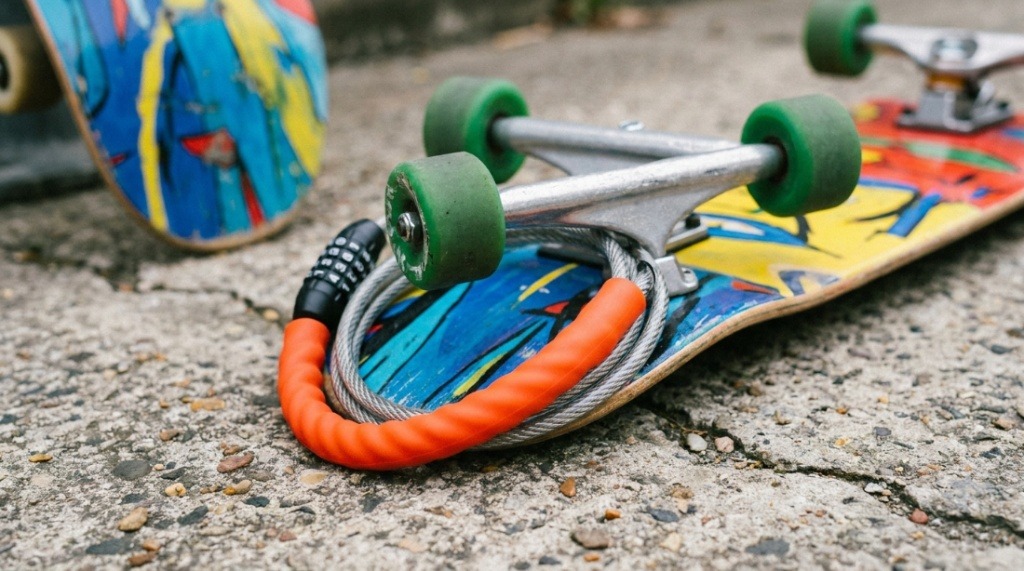
A skateboard lock is made specifically for boards, often as a cable, strap, or compact locking mechanism sized to wrap around a deck or truck. A U-lock (also called a shackle lock) is the rigid, heavy-duty lock cyclists use, made from hardened steel in a U shape. The core difference is that skateboard locks prioritize convenience and portability, while U-locks prioritize resistance to cutting and prying.
That single trade-off explains almost everything else in this comparison.
How each lock engages a skateboard
A U-lock needs to pass its shackle around a truck, a pair of wheels, or the deck edge, then close around a fixed object like a rack or pole. Because the shackle is rigid, you need enough clearance around the anchor point. Thin poles, tight racks, and thick decks can make this difficult. Skateboard-specific locks use flexible cable or webbing, so they thread through odd shapes more easily but generally offer less cut resistance.
Weight and carry differences
U-locks add noticeable weight to your bag or pocket, which is why many skaters leave them at home. Skateboard locks are designed to be carried on the board itself or clipped to a belt loop, so they are less likely to be left behind. The lock you actually carry is more useful than the stronger one you leave in a drawer, and that reality shapes a lot of real-world decisions.
Does a U-Lock Actually Protect a Skateboard Better?
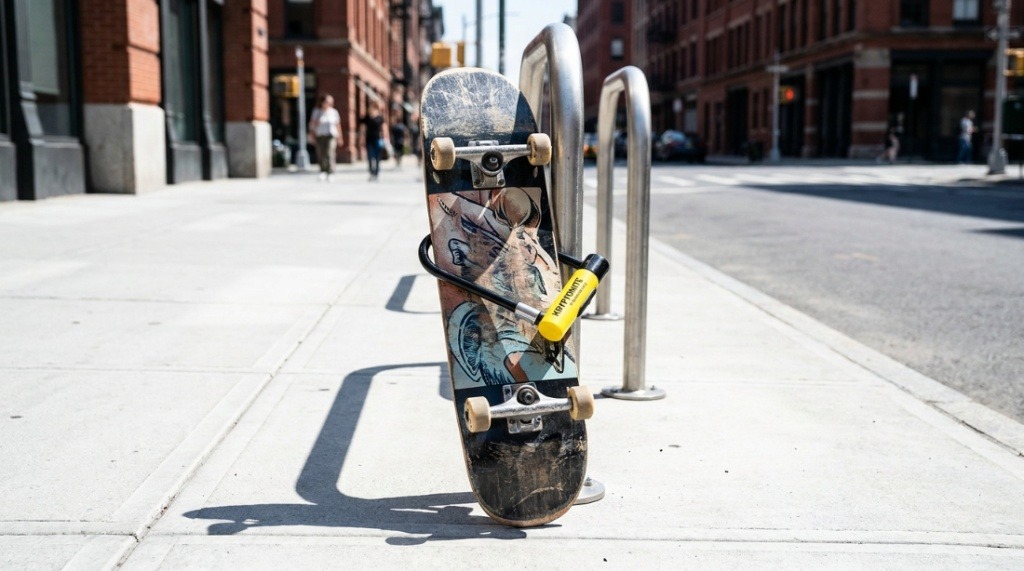
Against cutting and prying, yes. A quality U-lock with a hardened steel shackle is significantly harder to defeat with common hand tools than a thin cable lock. But the advantage only matters if you can actually lock the board in a way that removes easy leverage.
Where U-locks fall short on skateboards
Skateboards are awkward shapes. Thieves do not need to break a lock if they can unscrew a truck, pop a wheel off, or slide the deck free. A U-lock that only captures a wheel or a single truck bolt may allow a thief to disassemble the board and walk off with the valuable parts. To use a U-lock well, you generally need to capture the deck and a truck together, which requires more space and effort than many people expect, for a complete gear upgrade, check out our guide on the ultimate skateboard hardware kit for smooth setup.
Where U-locks win
For longer stops, crowded areas, or campuses with a history of board theft, a U-lock’s cut resistance gives you a real margin of safety. It also doubles as a bike lock if you ride and skate, so the cost can be justified across two uses.
Comparison: Skateboard Lock vs U-Lock at a Glance
| Factor | Skateboard Lock | U-Lock |
|---|---|---|
| Cut resistance | Low to moderate | High with quality hardened steel |
| Weight and bulk | Low, easy to carry | High, can be inconvenient |
| Ease of use on a board | Designed for decks and trucks | Requires clearance, sometimes awkward |
| Best for | Short stops, low-risk areas | Longer stops, higher-risk areas |
| Main weakness | Vulnerable to cutters and bolt removal | Heavy, and can leave parts exposed if locked poorly |
Is an Anti-Theft Skateboard Lock Worth It?
It depends on how and where you leave your board. An anti-theft skateboard lock is worth it if your typical scenario is a short stop, a semi-visible location, and a board you could replace without major financial pain. It is not worth relying on if you regularly leave a board unattended for hours in public, high-traffic areas.
A useful way to think about it: match the lock to the risk. Ask yourself three questions before deciding.
- How long will the board be unattended? Minutes are different from hours.
- How visible and busy is the location? A busy plaza with cameras is different from a quiet alley.
- How replaceable is the board? A cheap complete is different from a custom setup.
Realistic scenario examples
If you are grabbing coffee and your board sits ten feet away in view, a lightweight skateboard lock is a reasonable deterrent that also keeps you from forgetting it. If you are in class or at work for hours, the same lock gives you false confidence. In that case, a U-lock used correctly, or not leaving the board at all, is the better plan.
Common Mistakes That Defeat Any Lock
Most skateboard thefts do not involve defeating a lock at all. They involve a lock that was easy to bypass because of how it was used.
- Locking only a wheel. Wheels and trucks are often removable, so the rest of the board can walk away.
- Leaving slack. Extra slack gives a thief room to use leverage or cutting tools.
- Locking to a weak or removable anchor. If the rack or post can be lifted or unscrewed, the lock is irrelevant.
- Using a worn or cheap cable. Thin cables can be cut quickly with basic tools.
- Locking in the same predictable spot every day. A thief who watches your routine can plan around it.
How to lock a skateboard properly
- Thread the lock through a truck and over the deck so the board cannot be slid free.
- Capture the deck and truck together, not a single loose part.
- Choose a fixed, solid anchor that cannot be lifted or unscrewed.
- Keep the lock snug so there is minimal slack.
- Position the board so the lock and board are visible, not hidden behind objects.
Which Should You Choose?
Choose a U-lock if your board is valuable, your stops are long, or you lock up in areas with regular theft. Choose a dedicated skateboard lock if your priority is carrying it every day and you mainly make short, low-risk stops. Some skaters use both approaches depending on the trip, keeping a light lock for quick errands and a U-lock for longer commitments.
If you are still unsure, start with the risk, not the product. The strongest lock in the world does not help if it stays home, and the lightest lock does not help if you are gone for hours. Pick the option you will actually use for the situation in front of you.
Frequently Asked Questions
Can a thief steal a skateboard even with a lock on it?
Yes. Locks reduce the risk, especially against quick grab-and-go theft, but no lock makes a board theft-proof. A determined thief with the right tools and enough time can defeat most locks, and poorly locked boards can be disassembled without cutting anything.
Is a cable skateboard lock strong enough?
For short stops in low-risk areas, a quality cable or strap lock can be enough to deter opportunistic theft. Against someone with cutting tools, thin cables offer limited resistance, so treat them as a deterrent rather than real security.
Can I use a bike U-lock on a skateboard?
Often yes, if there is enough clearance to pass the shackle around a truck and anchor. The challenge is capturing the deck and truck together rather than just a wheel, since leaving parts exposed makes the board easier to disassemble and steal.
Do skateboard locks work on electric skateboards?
They can, but electric boards are heavier and often more expensive, which raises the risk level. For an electric skateboard, a stronger lock and a more secure anchor are usually worth it, and long unattended stops are best avoided entirely.
What is the safest way to leave a skateboard?
The safest option is not leaving it unattended at all. If you must, lock it through the deck and a truck to a solid, fixed anchor in a visible, busy location, and keep the stop as short as possible.
How much should I spend on a skateboard lock?
Spend in proportion to your board’s value and your risk level. A cheap lock can be fine for a quick, low-risk stop, while a higher-quality U-lock makes more sense for a valuable setup or regular long stops.
Conclusion
U-locks win on strength, and skateboard locks win on convenience. The right choice comes down to how long you leave your board, how risky the location is, and how much your setup is worth. For short, visible stops, a lightweight skateboard lock can be a sensible deterrent. For longer or higher-risk situations, a quality U-lock used correctly through the deck and truck is the more reliable option. Whatever you pick, lock it snugly to a solid anchor and keep an eye on it when you can.