Key Takeaways
- Technology removes old barriers like location, capital, and connections.
- Women-led startups still receive only about 2% of venture capital dollars.
- Digital tools help disabled, rural, and minority founders reach global markets.
- The broadband gap remains the biggest blocker to true inclusion.
- Inclusive startups often outperform, so fairness and profit go hand in hand.
Entrepreneurship has always promised a simple deal. Work hard, build something useful, and earn your own future. However, the door to that deal never opened equally for everyone. Location, background, and money decided who got a real chance. Today, technology is quietly rewriting those rules. Affordable tools, online markets, and mobile payments now reach people that banks and investors ignored for decades. This article explores how that shift works, where it still falls short, and what founders can do next.
Why Inclusive Entrepreneurship Matters More Than Ever
Inclusion is not only a moral goal. It is an economic engine. Research from the Kauffman Foundation shows that new businesses create most net new jobs in America. Therefore, every blocked founder represents lost jobs and lost local growth. When entire groups face barriers, whole communities fall behind.
The waste is measurable. BCG research found that startups with at least one female founder generate higher revenue per dollar invested than all-male teams. Additionally, McKinsey reports that companies with diverse leadership often outperform their peers on profit. So the logic is clear. More diverse founders mean more ideas, more competition, and stronger economies.
Unfortunately, the playing field remains uneven. Female-led startups received roughly 2% of U.S. venture capital dollars in recent years, according to Crunchbase data. Meanwhile, Federal Reserve studies show Black business owners face loan denial rates far above white applicants with similar profiles. Talent exists everywhere. Access does not. That gap is exactly where technology steps in.
How Technology Opens Doors That Stayed Closed
Technology attacks old barriers one by one. Consider each barrier that once stopped a founder cold.
- Location: Online stores let a rural seller reach customers in any country.
- Capital: Crowdfunding and mobile loans replace the gatekeeping of traditional banks.
- Skills: Free courses teach marketing, accounting, and design to anyone with a phone.
- Connections: Social platforms give small brands the same audience reach as big firms.
- Disability: Screen readers, voice tools, and remote work open careers that offices once closed.
The impact reaches across the globe. According to the World Bank Global Findex database, roughly 1.4 billion adults still lack bank accounts. However, mobile money has connected hundreds of millions of them in the past decade. A farmer with a basic phone can now save, borrow, and accept payments for the first time. That single change can turn a subsistence trader into a real business owner.
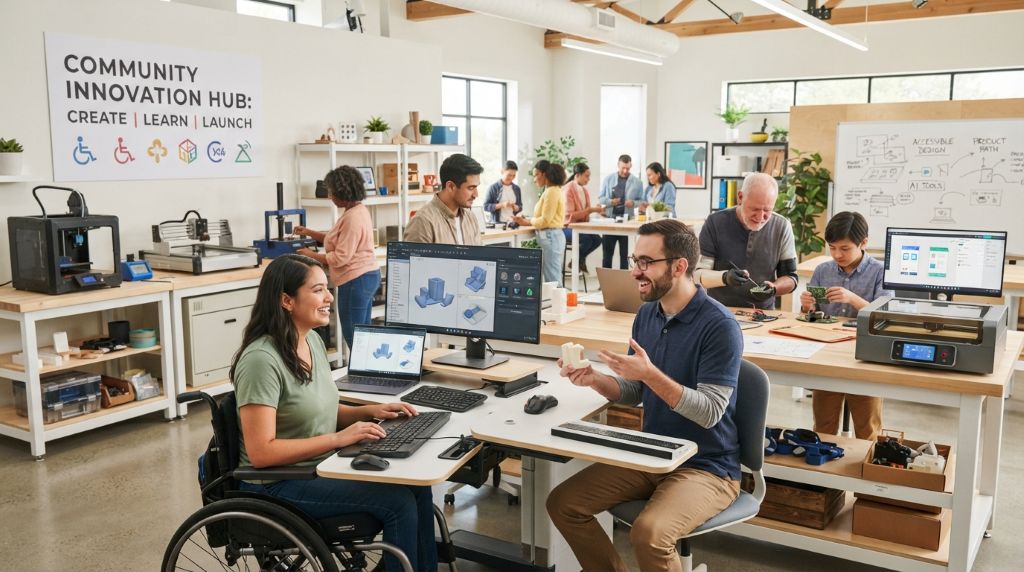
My own view comes from watching a neighbor, Marcus. He lost mobility in a workplace accident and assumed his working life was over. Instead, he built an online store selling adaptive camping gear. He managed everything from his wheelchair at home. His customers now span three countries. Technology did not give him special treatment. It simply removed the stairs.
The Funding Gap: Where Tech Helps and Hurts
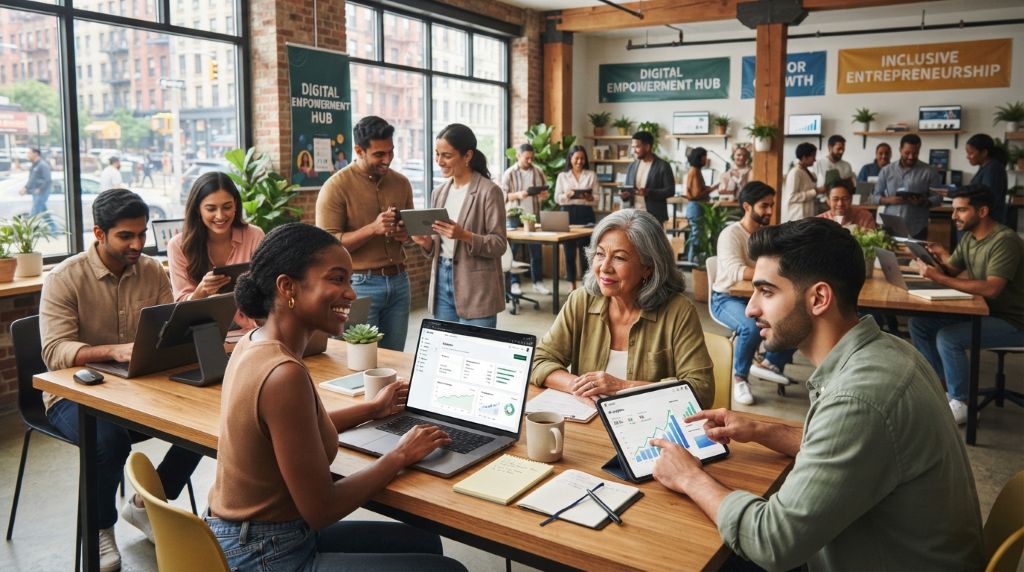
Money remains the hardest barrier for underrepresented founders. Traditional venture capital still flows to a narrow group, often graduates of the same schools and zip codes. However, technology is creating honest alternatives that bypass the old gatekeepers.
Crowdfunding platforms now raise billions for small businesses each year. These platforms judge a product by its appeal, not by the founder’s background. Additionally, revenue-based lenders and community investment apps look at real business data instead of credit history alone. A founder with steady sales can secure funding that a bank would never consider.
Still, tech alone cannot fix bias inside decision-making rooms. Algorithms trained on past lending data can repeat old discrimination with new speed. Therefore, experts urge careful design and regular audits of these systems. Regulation is catching up, but slowly.
The smartest founders also stop waiting for permission. Many now bootstrap with cheap software, pre-sell products online, and grow without outside investors. This path trades speed for control. Moreover, it proves demand before anyone writes a check. For groups excluded from capital networks, patience often beats the pitch meeting.
The Digital Divide: The Barrier Nobody Should Ignore
Inclusion has a hard limit. If people lack internet access, none of these tools matter. The Federal Communications Commission estimates that millions of Americans, mostly rural and tribal, still lack fixed broadband access. Globally, billions remain offline or pay too much for slow connections.
This divide follows old lines of income and geography. Therefore, every inclusive policy must start with connection. Communities that ignore this step will watch opportunity pass them by again.
Some solutions are already working. Public libraries offer free access and digital training. Mobile-first tools work on cheap phones instead of costly laptops. Additionally, governments now fund rural broadband through real budgets, not just speeches. Progress is real, yet uneven. Founders and local leaders must keep pressure on both public and private players.
Here is the practical lesson. Before building digital programs, check actual local access. Design for low bandwidth. Offer phone support. These small choices decide whether inclusion is real or just a slide deck.
Practical Steps Founders and Communities Can Take
Inclusive entrepreneurship grows through deliberate action, not luck. Both founders and community leaders hold tools right now.
Founders can start with these steps:
- Use free or low-cost platforms before spending on expensive systems.
- Join online communities where underrepresented founders share real advice.
- Pre-sell products to test demand without debt.
- Learn basic data skills to make evidence-based decisions.
- Ask for help early through mentorship programs and local incubators.
Communities and leaders play a role too. They can fund digital training centers, simplify business registration, and connect local founders to buyers. Additionally, established companies can open supplier lists to small and minority-owned businesses. Every one of these actions widens the door for someone else.
The core idea stays simple. Remove one barrier at a time. Each removed barrier lets another Marcus, or another Maria, start building. Over years, those individual wins compound into stronger towns and fairer economies.
FAQs
What is inclusive entrepreneurship?
It is the practice of making business ownership reachable for everyone, regardless of background, location, gender, or ability.
How does technology help minority founders?
It lowers costs, expands markets online, and offers funding paths outside traditional banks and investor networks.
Can a business really start with almost no money?
Yes. Free website builders, social media, and pre-orders let many founders launch for under a few hundred dollars.
What is the biggest barrier to digital inclusion?
Unequal internet access. Without reliable broadband or mobile data, no digital tool reaches the founder.
Do inclusive businesses actually perform better?
Often, yes. Studies from BCG and McKinsey link diverse founding teams with stronger revenue and returns.
Final Thoughts
Technology has handed more people than ever a genuine shot at business ownership. Costs have collapsed, markets have expanded, and funding options have multiplied. However, the work is not finished. The funding gap, the broadband divide, and hidden bias still block many talented people. Therefore, inclusion requires effort from founders, investors, and communities alike. When financial disputes or lost-income questions arise, resources such as how financial expert witnesses strengthen economic damage claims can also help explain how economic losses are evaluated. Marcus built his store because the tools finally met his determination halfway. Millions more are waiting for the same chance.
Have you seen technology open a door in your own community, or has something still held you back? Share your story in the comments below. Additionally, if this article resonated with you, pass it to someone who needs that first push.