The cycling world is heading to Canada. From September 20 to 27, 2026, Montréal becomes the centre of global road racing when it hosts the 99th edition of the sport’s most prestigious annual event. Close to 1,000 elite riders from more than 75 countries will compete across 13 events, chasing the rainbow jersey that identifies the world’s best road cyclists.
This is the biggest sporting event in Montréal since the 1976 Summer Olympics. For cycling fans in North America, it is the first chance in more than a decade to watch world championship road racing on home soil. Here is everything you need to know before it begins.
Why Montréal and Why 2026 Is Historic
Montréal has a deep connection to road cycling’s world championships. In 1974, the city hosted the event for the first time ever held outside of Europe. That year, Eddy Merckx won the elite men’s title and Geneviève Gambillon took the women’s crown. Fifty-two years later, the event returns to the same city.
This will be only the third time Canada has hosted the championships, after Montréal in 1974 and Hamilton, Ontario, in 2003. The event is also significant for another reason: it comes one year before the so-called super-Worlds in Haute-Savoie in 2027, where multiple cycling disciplines will combine into one mega-event. The 2026 edition in Montréal, therefore, stands as the final standalone road worlds before that format change.
The organizing committee has support from the City of Montréal, the Government of Quebec, and Tourisme Montréal. Attendance is expected to reach close to 500,000 spectators across the eight racing days, and the event is projected to draw an estimated 200 million television viewers worldwide.
Full Event Schedule
All 13 events finish on Avenue du Parc in Montréal. Time trial races take place from September 20 to 22, followed by a rest day on September 23, and then all road races from September 24 to 27.
| Date | Event | Distance |
| Sun, Sep 20 | Elite Women Individual Time Trial | 39.9 km |
| Sun, Sep 20 | Elite Men Individual Time Trial | 39.9 km |
| Mon, Sep 21 | Under-23 Men Individual Time Trial | 32.1 km |
| Mon, Sep 21 | Under-23 Women Individual Time Trial | 20.2 km |
| Tue, Sep 22 | Junior Men Individual Time Trial | 20.2 km |
| Tue, Sep 22 | Team Time Trial Mixed Relay | 40.2 km |
| Tue, Sep 22 | Junior Women Individual Time Trial | 11 km |
| Wed, Sep 23 | Rest day | — |
| Thu, Sep 24 | Under-23 Women Road Race | 134 km |
| Thu, Sep 24 | Junior Men Road Race | 134 km |
| Fri, Sep 25 | Under-23 Men Road Race | 174.2 km |
| Sat, Sep 26 | Elite Women Road Race | 180 km |
| Sun, Sep 27 | Elite Men Road Race | Approx. 265 km |
The two most watched events are the elite road races on Saturday and Sunday. These draw the biggest crowds and the most competitive fields of the entire week.
The Routes: City, River, Mountains and a Famous Circuit
The course design for 2026 is one of the most talked-about aspects of the event. It marks a clear departure from the extreme mountain climbing that defined the two previous editions in Zurich and Kigali. Montréal brings back the classics-style circuit racing that rewards punchy, aggressive riders.
The Time Trial Route
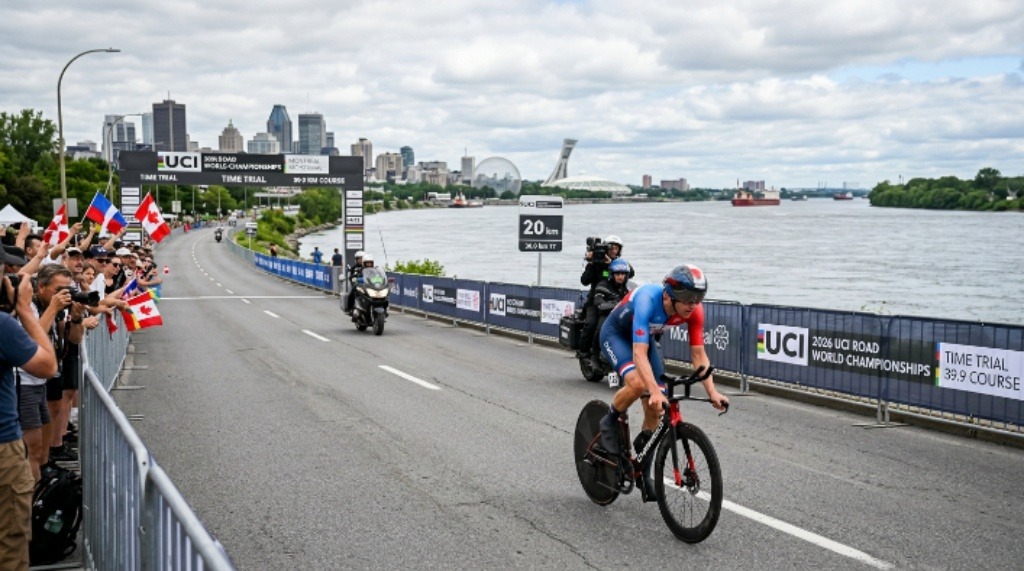
The elite time trial covers 39.9 km with 195 metres of elevation gain. The route begins in Montréal and winds through the city streets before running along the banks of the St. Lawrence River. Riders then cross the Samuel-De-Champlain Bridge, orbit the Circuit Gilles-Villeneuve, which hosts the annual Formula 1 Canadian Grand Prix, and return across the Concorde Bridge before heading to the finish on Avenue du Parc. The route is mostly flat and technical, rewarding specialists in aerodynamics and pacing over all-round climbers.
The Elite Road Race Route
The elite road races for both men and women begin in Brossard, a city located south of Montréal in the Montérégie region. The peloton then passes through eight municipalities, including Carignan, Chambly, Mont-Saint-Hilaire, Richelieu, Saint-Jean-Baptiste, Saint-Jean-sur-Richelieu, and Saint-Mathias-sur-Richelieu, before crossing the Samuel-De-Champlain Bridge into the city.
Once in Montréal, all road races conclude on the Mont-Royal circuit. This 13.4 km finishing circuit delivers 269 metres of elevation gain per lap and features two challenging climbs. The first is the Côte Camillien-Houde, 1.8 km at an average gradient of 8 percent. The second is the Côte de la Polytechnique, which includes sections exceeding 11 percent. After cresting the Polytechnique, riders navigate the false flat on Avenue du Parc all the way to the finish line beneath the towering monument to Georges-Étienne Cartier.
The women’s race covers 180 km in total with 2,502 metres of elevation gain. The men’s route adds extra distance in the early parcours before hitting the same finishing circuit.
This course design strongly favours classics specialists and punchy one-day racers over pure climbers and Grand Tour stage winners. That distinction is crucial for understanding the rider selection and team strategy.
Riders to Watch
The 2026 course profile has attracted enormous excitement because it opens the door to a much wider range of potential winners than recent editions.
Men’s Elite Race
Mathieu van der Poel is among the most anticipated starters. The Dutch champion skipped the 2025 worlds in Rwanda, where the climbs did not suit his strengths, but the Montréal circuit is tailor-made for his attacking, explosive style. Wout van Aert, Jasper Philipsen, and Mads Pedersen are all confirmed to have the Montréal worlds circled on their calendars. Each rider excels on circuits that blend short punchy climbs with technical finishes.
However, defending champion Tadej Pogačar will not simply give up the rainbow jersey. The Slovenian superstar has won back-to-back world titles and may adapt to the punchier demands of Montréal more readily than critics expect. Remco Evenepoel, the 2022 champion and a dominant time trialist, is another top favourite, particularly for the individual time trial on September 20.
Other names with genuine title ambitions include Biniam Girmay, Michael Matthews, Tom Pidcock, Ben Healy, Paul Seixas, and Isaac del Toro. North American fans will be eager to see a strong home contingent from Canada, the United States, and Mexico.
Women’s Elite Race
The women’s field is equally deep. Lotte Kopecky of Belgium is a consistent favourite on punchy circuits and will be one of the strongest riders in the peloton. Pauline Ferrand-Prévot, who dominated cross-country mountain biking before returning to road racing, brings exceptional fitness and tactical intelligence.
Demi Vollering, Elisa Longo Borghini, and Marlen Reusser are all expected to challenge for the title. Additionally, Canada’s own Magdeleine Vallières will start as defending champion, having made history in Kigali 2025 by winning Canada’s first elite road world championship. Defending her title on home soil would be one of the great moments in Canadian sporting history.
The Rainbow Jersey: What Winning Means
The championship is not run by trade teams. Every rider represents their nation, which adds an entirely different dimension to the competition compared to regular WorldTour events. National coaches pick their squads, select who receives team support, and design race tactics to lift a single rider to the top step of the podium.
The winner of each category earns the right to wear the rainbow jersey in all races of that discipline until the next championships. This iconic jersey, with its five horizontal stripes representing the UCI’s founding continents, is the most recognizable and coveted garment in professional cycling. Riders who wear it often describe it as a transformative experience, though it also brings the pressure of defending the title every week for the entire following season.
How to Watch the 2026 Championships
The event is free to attend in person in Montréal. Organizers urge visitors to book accommodation early, as hotels close to the venue are filling up quickly. Road closures begin two hours before each race, and streets reopen as quickly as possible after the riders pass.
For those watching at home, broadcast information for the Montréal edition follows the standard UCI Road World Championships pattern, with rights split across several platforms and networks depending on your country.
| Region | Broadcaster / Platform |
| USA | FloBikes, HBO Max |
| Canada | FloBikes |
| United Kingdom | BBC iPlayer (free), TNT Sports |
| France | France Télévisions |
| Belgium | RTBF / Sporza |
| Italy | RAI / RAI Play |
| Spain | RTVE / Teledeporte |
| Netherlands | NOS |
| Australia | Stan Sport (AU$20/month) |
| Rest of world | UCI YouTube channel (geo-restricted) |
In the United States, FloBikes carries many UCI WorldTour and championship events. Pricing runs at $39.99 per month or $149.99 for an annual plan. HBO Max also covers significant UCI events for US viewers at $16.99 per month for the standard plan.
In the UK, the BBC traditionally provides free coverage of the elite time trials and elite road races. Viewers in France, Belgium, Italy, Spain, and the Netherlands can access free-to-air national broadcaster coverage for the major races.
In countries where no dedicated broadcast deal applies, the UCI’s own YouTube channel streams races live without charge. However, this stream is geo-restricted in territories that already have a TV rights holder, so availability depends on your location.
Therefore, checking the official UCI website at uci.org before each race day is the safest way to confirm which platform carries your race in your territory.
Getting to Montréal and Planning Your Visit
Montréal is well served by international flights into Montréal-Trudeau International Airport. The city’s public transport network, including the metro and STM buses, provides good access to most race venues. However, several bus routes will see temporary service adjustments between September 13 and 27 due to road closures. Visitors should check the STM website for up-to-date routing information before traveling on race days.
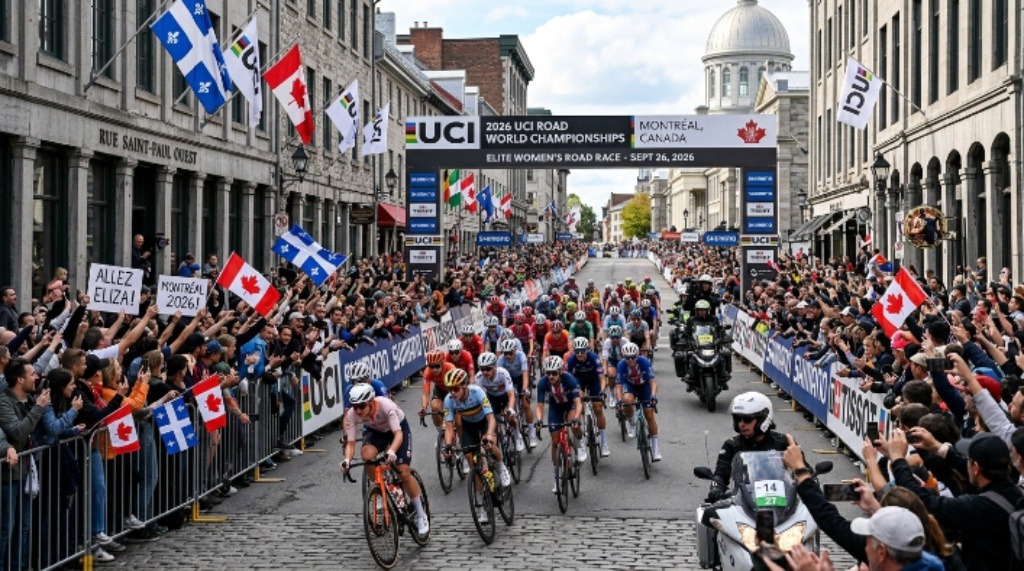
The finish line on Avenue du Parc, beneath the Cartier monument on the slopes of Mont-Royal, is one of the most visually spectacular finish settings in world cycling. Fans who plan to watch from this area should arrive early on the elite race days, as crowds build quickly for the final laps of the Mont-Royal circuit.
The organizing committee has also invested in 36 kilometres of road resurfacing and upgrades across the race network as a lasting legacy of the championships. New bike lanes created for the time trial route will remain in place after the event as permanent infrastructure for Montréal residents.
Conclusion
The 2026 UCI Road World Championships runs from September 20 to 27 in Montréal, Canada, marking the 99th edition of the sport’s premier annual event. Thirteen races across individual time trials, road races, and a team time trial mixed relay will determine world champions in elite, under-23, and junior categories for both men and women. The time trial route threads through the city and along the St. Lawrence River past the Formula 1 circuit, while the elite road races leave from Brossard in the Montérégie region and finish on the punishing Mont-Royal circuit on Avenue du Parc. Riders like Van der Poel, Van Aert, Pogačar, Kopecky, and defending women’s champion Magdeleine Vallières headline a field of nearly 1,000 athletes from over 75 countries. Attendance is free and live, with an estimated 200 million viewers expected worldwide. US fans can watch via FloBikes and HBO Max, UK fans through the BBC and TNT Sports, and international audiences through their national broadcasters or the UCI YouTube channel. This is a historic edition of the sport’s greatest race, and September in Montréal will be the place to be for cycling fans everywhere.
Frequently Asked Questions
When and where is the 2026 UCI Road World Championships?
The championships take place from September 20 to 27, 2026, in Montréal, Quebec, Canada. All 13 events finish on Avenue du Parc in the city. Time trials run from September 20 to 22, and road races take place from September 24 to 27.
How many events are on the program and which categories compete?
There are 13 events in total: seven individual time trials, five road races, and one team time trial mixed relay. Categories include Elite Men, Elite Women, Under-23 Men, Under-23 Women, Junior Men, and Junior Women.
Is it free to watch the races in person?
Yes. Watching the races from the roadside in Montréal is completely free. Temporary road closures begin two hours before each race. Organizers recommend booking accommodation well in advance, as rooms near the venue are filling quickly.
Which riders are expected to compete in the elite road races?
The men’s field is expected to include Mathieu van der Poel, Wout van Aert, Tadej Pogačar, Remco Evenepoel, Jasper Philipsen, Mads Pedersen, Tom Pidcock, Biniam Girmay, and Ben Healy, among many others. The women’s field includes Lotte Kopecky, Pauline Ferrand-Prévot, Demi Vollering, Marlen Reusser, Elisa Longo Borghini, and defending champion Magdeleine Vallières of Canada.
How can US and international viewers watch the event live?
US viewers can watch via FloBikes or HBO Max. UK viewers have access through the BBC for free or TNT Sports. European fans in France, Belgium, Italy, Spain, and the Netherlands can watch on their respective national broadcasters. Fans in countries without a dedicated rights holder can stream races live on the UCI’s official YouTube channel, subject to geo-restrictions.