I used to lube my chain “whenever I remembered” — which meant once every few weeks, always after the damage was already done. My local bike shop mechanic finally showed me the chain checker reading: 0.6% elongation after just 1,100 miles. That chain should have lasted 2,500+. The problem was not the lube I used; it was how infrequently I applied it. A bike chain lubricant only protects while it is present — the moment it wears away, every pedal stroke grinds unprotected metal against abrasive particles. Proper chain maintenance intervals depend on your specific conditions, not arbitrary calendar schedules. A rider in dry desert dust needs reapplication every 25 miles while a rider in mild Pacific Northwest conditions might go 80 miles between applications. This guide provides exact interval recommendations based on your environment, riding style, and lube type — plus the sensory indicators that tell you when protection has failed regardless of mileage.
What Determines How Often You Need to Lube Your Chain?
Four factors determine lubrication frequency: environmental conditions (dust, moisture, temperature), lube type (dry depletes faster than wet), riding intensity (higher torque displaces lube faster), and chain cleanliness (contaminated chains consume lube faster than clean ones).
Factor breakdown:
- Environment (50% of frequency determination): Dusty conditions abrade lube films. Wet conditions wash lube away. High heat evaporates volatile carriers. Humid conditions slow evaporation but promote corrosion. Your riding environment is the single biggest determinant of interval.
- Lube type (25%): Dry wax lubes deplete in 25–60 miles. Wet oil lubes last 50–150 miles. Wax immersion lasts 150–300 miles. The product you choose directly sets your baseline interval.
- Riding intensity (15%): High-torque climbing squeezes lube from between rollers. Frequent shifting creates lateral forces that scrape lube from surfaces. More intense riding = shorter intervals.
- Chain condition (10%): A contaminated chain degrades fresh lube faster because existing abrasive particles break down new lubricant films. Clean chains maintain lube longer.
What Are the Recommended Intervals by Condition?
Specific mileage intervals range from 20 miles in extreme dust to 150+ miles in clean, mild conditions — with most mountain bikers falling in the 30–60 mile range for typical trail riding with dry lube.
| Condition | Dry Lube Interval | Wet Lube Interval | Signs to Watch |
|---|---|---|---|
| Heavy dust/sand (desert, summer) | 20–30 miles | Not recommended | Chain noise, visible dust buildup |
| Moderate dust (typical trails) | 30–45 miles | 40–60 miles | Shifting degradation, light noise |
| Low dust/clean trails | 45–60 miles | 60–100 miles | Subtle increase in pedal resistance |
| Wet/muddy conditions | Not recommended | 30–60 miles | Audible grinding, chain squeak |
| Mixed conditions | 25–40 miles | 40–80 miles | Any audible chain noise |
| Road/pavement (clean) | 60–100 miles | 100–150 miles | Chain becomes audible |
These are guidelines, not absolutes. Your specific combination of lube product, trail surface, weather, and riding style creates a unique interval. Use these ranges as starting points and adjust based on the sensory feedback your chain provides.
How Can You Tell When Your Chain Needs Lubrication Right Now?
Three sensory indicators tell you lubrication is needed immediately: audible chain noise (any grinding, squeaking, or increased sound), tactile roughness (chain feels dry and gritty when touched), and visual dryness (chain appears matte and dusty rather than having a slight sheen).
Indicator hierarchy (earliest to latest):
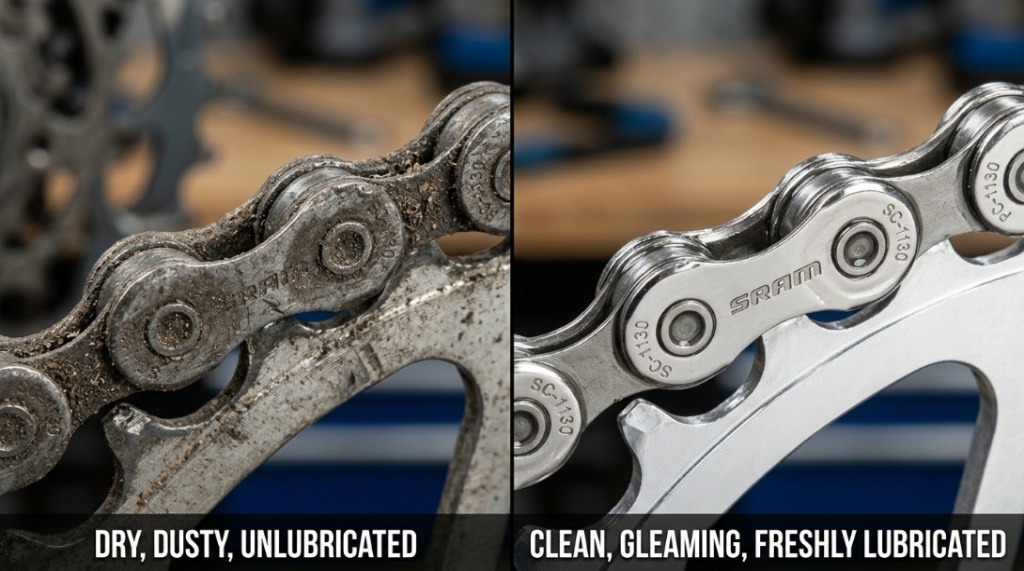
- Sound (earliest indicator): A properly lubed chain is nearly silent. Any audible chain sound — metallic ticking, grinding, squeaking, or increased baseline noise — indicates lube depletion. If you can hear your chain over tire noise, it needs lube.
- Shifting quality (mid indicator): Shifts become less crisp, hesitate, or require multiple clicks. Depleted lube increases friction between chain and cog teeth, impeding smooth lateral movement. If your normally-crisp shifter starts feeling vague, check lube status.
- Feel (late indicator): Pedaling resistance increases noticeably. The bike feels “heavier” to pedal. This indicates significant lube depletion where metal-on-metal friction is actively consuming your power. Damage is likely occurring at this stage.
- Visual (confirmation): Chain appears dry, dusty, and matte. No residual sheen or wax film visible. Touching the chain leaves a dry, gritty sensation on your finger. By this point, the chain has been unprotected for miles.
The rule: if you notice ANY of these indicators, lube as soon as possible. Do not wait for all four — the first sign of noise means protection is already compromised.
Should You Lube on a Time Schedule or Mileage Schedule?
Use mileage as the primary interval and time as a secondary check — lube degrades from use (mileage) faster than from sitting, but chains left unused for 2+ weeks can develop surface corrosion that requires fresh lubrication before the next ride regardless of remaining mileage capacity.
Scheduling approach:
- Primary trigger: Mileage. Track miles since last application. Lube when you approach your condition-specific interval (see table above). This accounts for actual chain use and wear.
- Secondary trigger: Time. If the bike sits unused for 2+ weeks, apply fresh lube before the next ride regardless of mileage since last application. Lubricant films degrade through oxidation and dust settling during storage.
- Override trigger: Conditions. If you encounter unexpected conditions (surprise rain on a dry-lubed chain, heavy dust on a freshly lubed chain), relube based on conditions rather than waiting for mileage interval.
Practical tracking: most riders do not precisely track chain mileage. A simple approach: lube before every ride that matters. For daily riders, establish a routine (every 2–3 rides for dry lube, every 4–6 rides for wet lube in appropriate conditions). The cost of one extra application is negligible; the cost of riding one application short is expensive.
Does Riding Frequency Change How Often You Should Lube?
Yes — daily riders need to lube more frequently by calendar (every 2–3 days) but can extend mileage intervals slightly because frequent use prevents the oxidation and contamination settling that occurs during storage between rides.
Frequency-adjusted schedules:
- Daily riders (5–7 rides/week): Lube every 2–3 rides (dry conditions) or every 4–5 rides (mild conditions). The chain never sits long enough for storage-related degradation. Fresh application every 60–100 miles total.
- Regular riders (3–4 rides/week): Lube every 2–3 rides. Check before each ride — if last application was more than 3 days ago AND conditions will be demanding, relube as prevention.
- Weekend riders (1–2 rides/week): Lube before every ride. The 5–6 day gap between rides allows enough degradation that fresh application before each ride ensures protection. Wipe and clean after each ride.
- Occasional riders (2–4 rides/month): Always lube before riding. The extended gaps between rides cause measurable lube degradation. Never assume last month’s application is still effective.
How Does Over-Lubing Cause Problems?
Applying too much lube or lubing too frequently without cleaning creates excess external residue that attracts dust, builds up between cogs, gums up derailleur pulleys, and can actually increase contamination-based wear — making over-lubing counterproductive in dusty conditions.
Over-lubing symptoms:
- Black paste buildup: Thick residue between cassette cogs indicates excess external lube collecting contamination
- Fling-off marks: Lube spots on chainstay, rim, or frame indicate far too much application
- Sticky chain exterior: A properly lubed chain should feel DRY externally. Stickiness means excess that will attract dust
- Gummed pulleys: Derailleur jockey wheels coated in paste indicate overflow lube collecting downstream
The solution: always wipe excess after application. The goal is lubrication INSIDE the rollers only. External lube serves zero function — it only creates problems. One drop per roller, backpedal to distribute, then wipe everything you can reach on the exterior. A properly lubed chain looks almost the same as a dry chain from the outside.
For product-specific application intervals and performance data in mountain biking conditions, chain lubricant intervals tested on mountain bike trails provides real-world durability data that reveals exactly how long specific products maintain protection in various trail conditions.
Conclusion
How often you lube your mountain bike chain depends on your specific combination of conditions, lube type, and riding intensity — but the universal rule is: when in doubt, lube sooner rather than later. A single unnecessary application costs pennies. A single ride on depleted lube costs measurable chain life. Track your mileage intervals, listen for chain noise, and establish a pre-ride routine that ensures protection is always fresh when it matters.
Whatever your schedule, the combination of consistent lubrication plus regular cleaning creates the maintenance discipline that extends chain life 2–3x beyond riders who lube randomly and never clean.
What is your lubrication routine — do you track mileage, go by sound, or have a set schedule? Share what works for your riding conditions.
Frequently Asked Questions
Can you lube a mountain bike chain too often?
Technically no — fresh lube cannot harm a chain. However, applying without cleaning first seals contaminants inside, and excess external lube attracts dust. The real problem is not frequency but technique: if you clean before each application and wipe excess after, you cannot over-lube. If you just squirt lube on a dirty chain repeatedly, contamination builds up even with frequent application.
Should I lube my chain before or after every ride?
Before. Fresh lube provides maximum protection during the ride when your chain actually experiences load and contamination. Post-ride lubing is less effective because the chain sits idle until next use — the protection degrades during storage rather than serving during riding. Clean after riding; lube before the next ride (ideally the night before for dry lube drying time).
How do I know if I am using enough lube per application?
One drop per roller (the cylindrical part that contacts cog teeth) is correct. After application and backpedaling to distribute, the chain should NOT drip or feel wet externally. If it does, you applied too much — wipe the excess. Internal lubrication happens from a single drop; excess sits externally serving only as a dust magnet.
Does chain speed affect how fast lube depletes?
Yes — faster chain speed (higher cadence) creates centrifugal force that gradually flings lube from chain surfaces. However, this effect is minor compared to contamination-based depletion. A rider spinning at 100 RPM in clean conditions loses lube only marginally faster than one at 70 RPM. Dust exposure overwhelms the cadence effect in real-world conditions.
Is it bad to ride with a completely dry chain for a short distance?
A short distance (under 5 miles) on a dry chain causes minimal measurable wear for a casual ride. However, the damage is not zero — every unlubricated rotation removes some metal. More importantly, riding dry in contaminated conditions (dust, dirt) is significantly worse than riding dry on clean pavement because abrasives accelerate unlubricated wear. Avoid dry-chain riding whenever possible, regardless of distance.
Do different chain brands need different lubrication frequency?
Marginally. Premium chains with tighter manufacturing tolerances and better surface treatments may hold lube slightly longer (10–15% extended intervals). However, the difference between brands is far smaller than the difference between riding conditions. A premium chain in heavy dust still needs lube every 25–35 miles — perhaps 5 miles longer than a budget chain in identical conditions. Focus on conditions, not chain brand, when setting intervals.
Should I increase lube frequency as my chain ages?
Yes — as chains wear, internal clearances increase (pins become slightly smaller within bushings). These larger gaps hold less lube and allow contamination entry more easily. A chain approaching 0.5% wear may benefit from 10–20% shorter lubrication intervals to compensate for reduced lube retention. However, if your chain has reached this wear level, replacement provides better protection than increased lubrication frequency.