You’ve finally decided to get into paddle boarding, or maybe you’re looking to upgrade your current setup. You have likely landed on the idea of an inflatable board because of storage constraints or the promise of portability. But as you browse through specs, that question keeps popping up: is a lightweight inflatable paddle board actually easy to carry? The short answer is yes, but there is more nuance to it than simply looking at the scale in your bathroom. While an inflatable board solves the roof-rack and garage-space problem, “easy to carry” depends on packed dimensions, backpack design, and your specific travel lifestyle. This guide breaks down exactly what portability means for an iSUP, what to look for, and how to avoid the common pitfalls that make carrying a board more of a chore than it should be.
Key Takeaways
- Most inflatable boards weigh between 15 and 25 pounds, making them significantly easier to manage than rigid fiberglass or epoxy boards that often exceed 30 pounds.
- Portability is not just about weight; the packed size of the rolled board and the quality of the carry backpack are critical factors for comfort.
- You do not have to sacrifice durability for a lighter weight; modern materials like woven drop-stitch fabric keep boards rigid while reducing mass.
- Consider full packages that include a pump and paddle, as these add weight to your carry load, even if the board itself is light.
- Carrying an iSUP is practical for most people, but you should assess your physical strength and grip endurance if you plan on hiking long distances to the water.
What Determines the Weight of an Inflatable Paddle Board?
When we talk about a lightweight inflatable paddle board, we are generally looking at the overall mass of the board itself before accessories are added. The weight is determined by the density of the PVC layers and the type of drop-stitch threading used inside the rails. Higher-end boards often utilize lighter military-grade PVC, while budget boards might use a heavier, thicker outer layer that adds mass. Furthermore, the number of layers—whether single or double—affects durability and weight. A single-layer board is light and easier to carry, but a double-layer board, while heavier, offers more resistance to punctures. Therefore, “easy to carry” sometimes means sacrificing a bit of ruggedness in exchange for a lighter load.
Comparing iSUP Weight to Hard Boards
To put portability into perspective, a standard rigid paddle board typically weighs between 28 and 40 pounds. That weight is distributed over a long, stiff shell, making it awkward to grip and balance on your head or under your arm. In contrast, an inflatable board is lighter, and because it flexes slightly, it is easier to hug against your body. Even the heaviest inflatable touring boards rarely exceed 25 pounds. This difference is massive when you have to walk from a parking lot to the shoreline. The inherent softness of the iSUP also means you don’t have to worry about banging it against doorframes or car roofs while maneuvering it to your launching spot.
Packed Size and the Backpack Experience
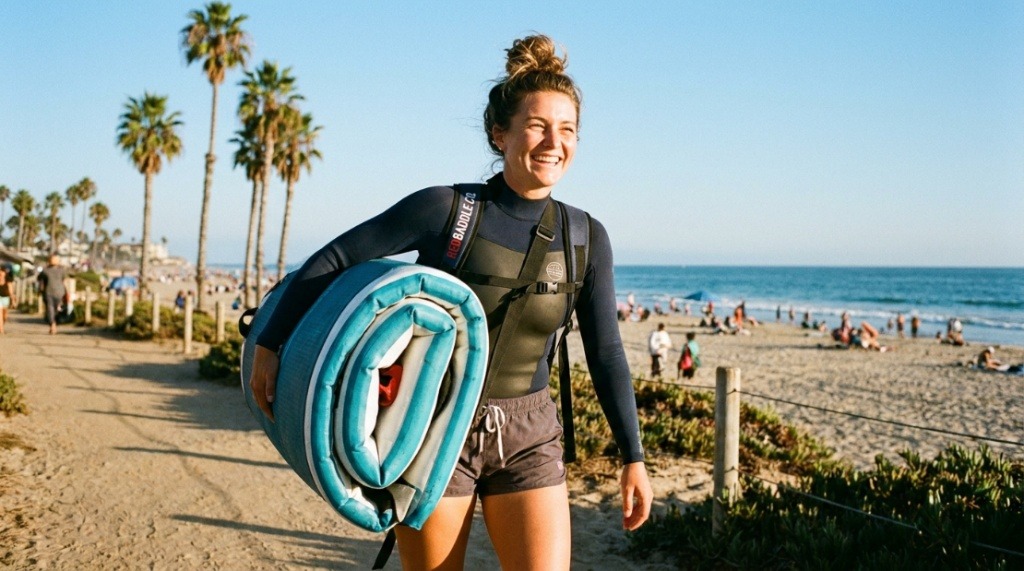
Weight is only half of the story. To actually get the board to the water, you have to roll it up and stuff it into a backpack. This is where the “easy to carry” claim is truly tested. The packed dimensions vary by board width and thickness. A 10’6” board might compress into a roll the size of a large sleeping bag, while an 11’6” touring board might be significantly longer. When you put that rolled board into its backpack, the overall bulk can make you feel off-balance, especially if the bag lacks proper compression straps or a supportive hip belt.
To capture all your water sports adventures clearly and securely without water damage, make sure to buy a durable camera for surf and snorkeling.
Why Backpack Design Matters
Not all iSUP backpacks are created equal. A good backpack will have padded shoulder straps and a sternum strap to distribute the weight away from your neck. A great backpack will also have a hip belt, which transfers the load to your hips—the strongest part of your body. If the backpack has thin, unpadded straps, a 20-pound board will feel like 50 pounds after a ten-minute walk. You should also check whether the bag is a “wheeled” version or a “backpack” version. Some larger boards (over 11 feet) are too long to carry comfortably on your back and are often dragged using wheels, which is easier on the spine but difficult on uneven terrain.
Don’t Forget the Accessories: The Total Carry Weight
One common mistake is assuming that the weight listed on the spec sheet is all you’ll carry. That weight is almost always just the board. You also need to carry the pump, the paddle, and often a coiled leash and a small repair kit. These essentials add between 6 and 10 pounds to your setup. A backpack that holds a 17-pound board might weigh 26 pounds once you add the triple-action pump and a 3-piece carbon paddle. When you test the ease of carrying, always consider the “total ensemble weight” rather than just the board weight. This distinction is crucial for those with back problems or smaller physical frames.
Breakdown of iSUP Package Weights
| Component | Typical Weight Range | Impact on Carrying |
|---|---|---|
| Board Only (10-11 ft) | 15 – 22 lbs | Primary load; manageable for most adults. |
| Triple-Action Hand Pump | 2.5 – 4 lbs | Bulky and awkward; fits in the backpack’s outer pocket. |
| 3-Piece Paddle (Plastic/Fiberglass) | 2 – 3.5 lbs | Usually stored in the main compartment or side sleeve. |
| Leash & Accessories | 1 – 2 lbs | Distributed in the front pocket. |
| Total Backpack Weight | ~25 – 32 lbs | Similar to a heavy hiking pack; requires good posture. |
How Far Are You Walking? Real-World Scenarios
The ease of carrying an inflatable board depends heavily on the distance between your transportation and the water. If you are parking right next to a sandy beach, the portability factor is a huge win; you can simply sling the backpack over your shoulder and walk 50 feet to the shoreline. However, if you are planning to hike a mile to a secluded mountain lake, the portability becomes more complex. While the board is lighter than a hard board, the backpack is bulky and shifts your center of gravity. For long treks, look for boards that weigh under 18 pounds, as this minimizes the strain on your lower back during a steep incline.
Hand-Carrying vs. Backpacking
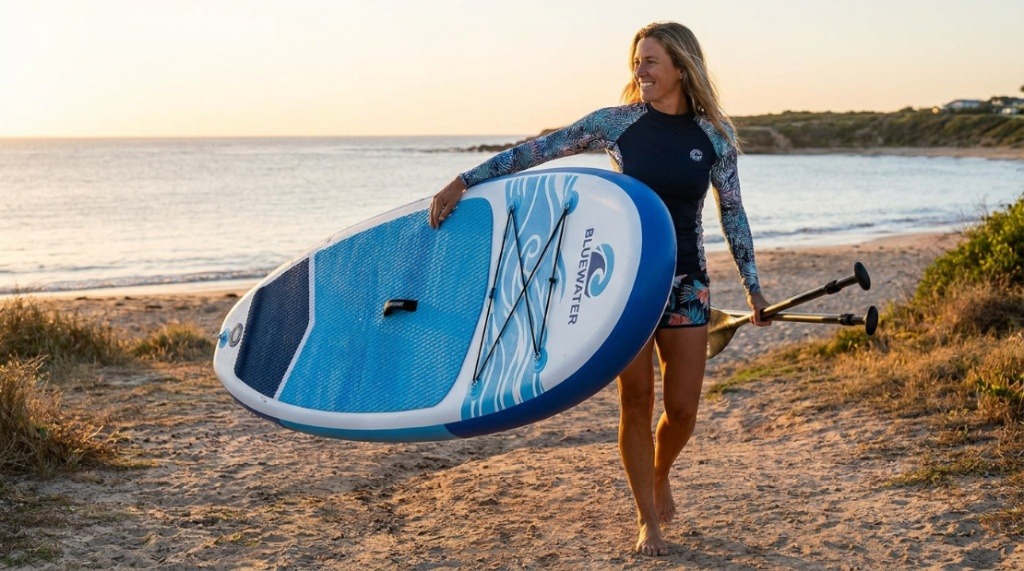
If you are just moving the board from the car to the water, hand-carrying the rolled-up board by the handle (without the backpack) is a viable option. Most boards have a molded center handle that is comfortable to grip. However, you cannot walk far with this method because the board must be rolled tightly to fit in your hand. If you are facing a long walk, the backpack method is superior. Look for boards that feature a roll-up process that minimizes the diameter of the rolled bundle. A smaller roll diameter makes it much easier to fit into the backpack and keep the load close to your back.
Weight vs. Durability: Is Lighter Always Better?
Consumers often ask if lighter boards are fragile. In the past, heavy boards were considered “tank-like,” while light boards were seen as flimsy. Today, technology has resolved this trade-off. A lightweight inflatable paddle board uses high-tenacity yarns in the drop-stitch core and lighter PVC laminates that do not absorb water or degrade quickly. You can find boards that are both light and stiff. However, you should be cautious of ultra-cheap boards that are light because they simply use less material or have a lower PSI rating. A low PSI rating (under 12 PSI) results in a mushy board that feels unstable, making it harder to carry because it flops around. A quality board should be rigid at 15 PSI, allowing it to be carried without bending in the middle.
Assessing Your Physical Capability
Let’s be realistic about physical strength. A 15-pound board is incredibly light—about the weight of a large watermelon. Most people can manage that. But when that weight is strapped to your back and you are walking 300 meters, fatigue sets in. If you have a history of shoulder injuries, the act of holding the backpack straps to swing it onto your back might be the hardest part. In such cases, consider a board package that comes with a wheeled backpack rather than a traditional backpack. Alternatively, choose a board shorter than 10 feet, which is lighter and has a smaller packed volume.
Which Paddler Should Choose a Lightweight iSUP?
Decision-making becomes easier when you match the board to the user. If you travel frequently and check your gear as airline baggage, a lightweight inflatable board is practically mandatory. Airlines often charge overweight baggage fees, and staying under the 50lb limit requires a board under 20 pounds. Furthermore, if you live in a city apartment without an elevator, carrying a 25-pound backpack up three flights of stairs is manageable, whereas carrying a 35-pound rigid board is not. Ultimately, the “carryability” of the board opens up paddle boarding to demographics that might not have considered it before—such as seniors, younger paddlers, or those with less upper-body strength.
The Inflation Consideration
While this article is about carrying, it is worth noting that a lightweight board is often easier to inflate. Because the material is thinner (in single-layer constructions), you will require fewer pumps to reach the target PSI. This saves energy before you even hit the water. Just remember that an “easy to carry” board is not necessarily an “easy to inflate” board if it lacks an efficient valve system. Look for a board with a large bore valve and try to use an electric pump if you are carrying the board to a remote location without a power source.
Frequently Asked Questions
Can one person easily carry an inflatable paddle board?
Yes, one person can easily carry an inflatable paddle board, provided the board fits in a proper backpack. The average weight of 15-20 pounds is significantly less than hard-shell alternatives, allowing a single adult to transport the entire system safely without assistance.
How long does it take to blow up a lightweight paddle board?
With a high-quality triple-action hand pump, it typically takes 5 to 8 minutes to reach the recommended PSI of 14-15. Using an electric pump reduces this time to about 3 minutes. The softer, lighter material does not resist the air flow, making the process faster than with heavier, thicker boards.
Is it safe to carry the board by the handle while walking?
It is safe to carry the board by the handle for short distances, like from a parking spot to the sand. However, because the board is flexible when rolled, the weight can shift. For distances over 200 yards, you should use the backpack to maintain balance and reduce strain on your arms and shoulders.
Do lightweight boards blow away in the wind when on land?
Yes, a lightweight inflatable board is susceptible to catching wind when it is fully inflated but resting on the grass or sand. If you take a break and leave the board on the ground, it is advisable to place your paddle or a small sandbag on it, as a gust could easily tumble it across the beach.
Can I put a lightweight paddle board in a regular suitcase?
Usually, no. Unless the board is specifically a “travel” model, the packed length of the board is 30-35 inches, which is longer than the typical airline suitcase dimension. You should travel with the backpack that comes with the board, as it is designed to accommodate the board and pump together.
Conclusion
So, is a lightweight inflatable paddle board easy to carry? Absolutely—when compared to the rigid alternatives. The combination of reduced mass, soft edges, and a well-designed backpack makes transporting your board to the water a fraction of the hassle of traditional paddle boards. The key takeaway is to focus not just on the board’s weight but on the entire package’s weight and the quality of the harness. If you focus on these factors, you will find that your new iSUP allows you to explore waterways you once avoided simply because the logistics of getting there were too difficult. Look for reputable brands that balance weight savings with durability guarantees, ensuring your portability does not compromise your on-water performance.