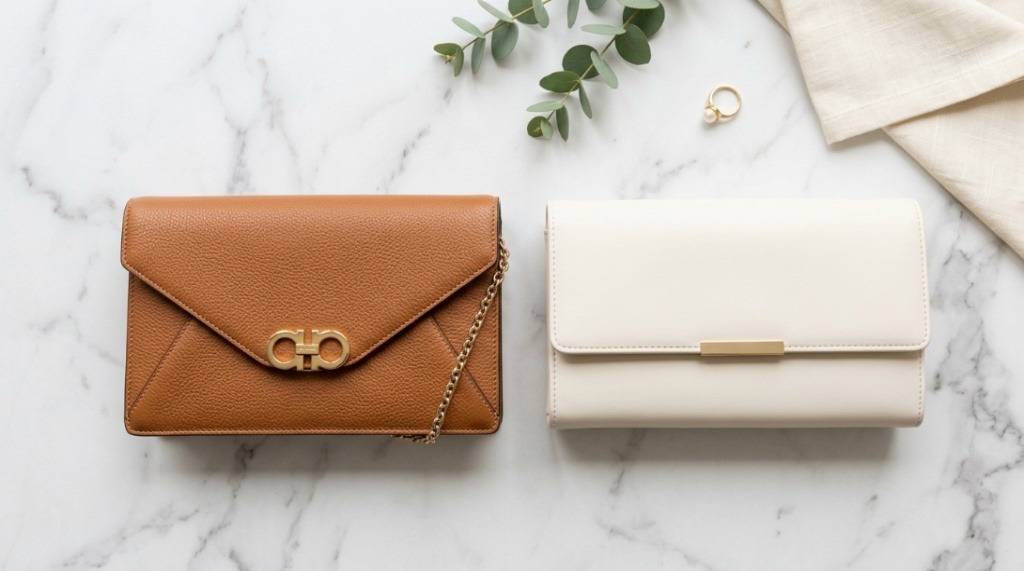
A $2,400 designer clutch and a $120 affordable alternative can sit side by side on a shelf — and most people won’t identify which is which from three feet away. Choosing between designer clutch bags and affordable options isn’t about quality versus garbage. It’s about understanding what you’re actually paying for at each price tier and deciding which benefits matter to your life. A designer clutch bag is a compact handbag produced by an established luxury fashion house — typically priced above $500 — featuring premium materials, brand heritage, and artisan-level craftsmanship. The real tension? Marketing creates artificial shame around affordable choices while simultaneously encouraging impulsive luxury spending beyond people’s means. Neither extreme serves you well. This guide objectively compares designer and affordable clutch bags across every factor that matters — materials, construction, longevity, cost-per-use, resale value, and real-world performance — so you can spend confidently at any budget level.
What’s the Real Difference Between Designer and Affordable Clutch Bags?
The real differences are material sourcing, finishing precision, hardware quality, and brand equity — not necessarily the fundamental ability to hold your belongings or complement your outfit.
Let’s break down where designer and affordable clutches genuinely differ versus where marketing creates perceived gaps:
| Factor | Designer ($500+) | Affordable ($50–$200) | Noticeable Difference? |
|---|---|---|---|
| Leather quality | Full-grain, hand-selected hides | Genuine leather (lower grade) or quality PU | Yes — touch and aging |
| Hardware | Solid brass or zamac, hand-polished | Zinc alloy, machine-finished | Yes — weight and longevity |
| Stitching | Often hand-stitched or precision machine-stitched | Machine-stitched | Subtle — visible up close |
| Edge finishing | Hand-painted, multiple coats | Single coat or raw | Yes — visible on light colors |
| Interior lining | Suede, lambskin, or silk | Polyester or cotton | Moderate — felt when opening |
| Design originality | Original, often trend-setting | Often inspired by luxury shapes | Depends on the brand |
| Brand recognition | Instantly identifiable to insiders | Unknown to most observers | Only to fashion-aware audiences |
| Resale value | Retains 40–80% of retail | Minimal to zero resale value | Yes — significantly |
The truth: at a cocktail party, across a dinner table, or in an event photo, the visual difference between a well-chosen $150 clutch and a $1,500 designer piece is often imperceptible. The tactile difference — how the leather feels, how the clasp clicks, how the weight sits — that’s where luxury justifies itself. Whether that justification matters depends entirely on your priorities.
When Does It Make Sense to Invest in a Designer Clutch Bag?
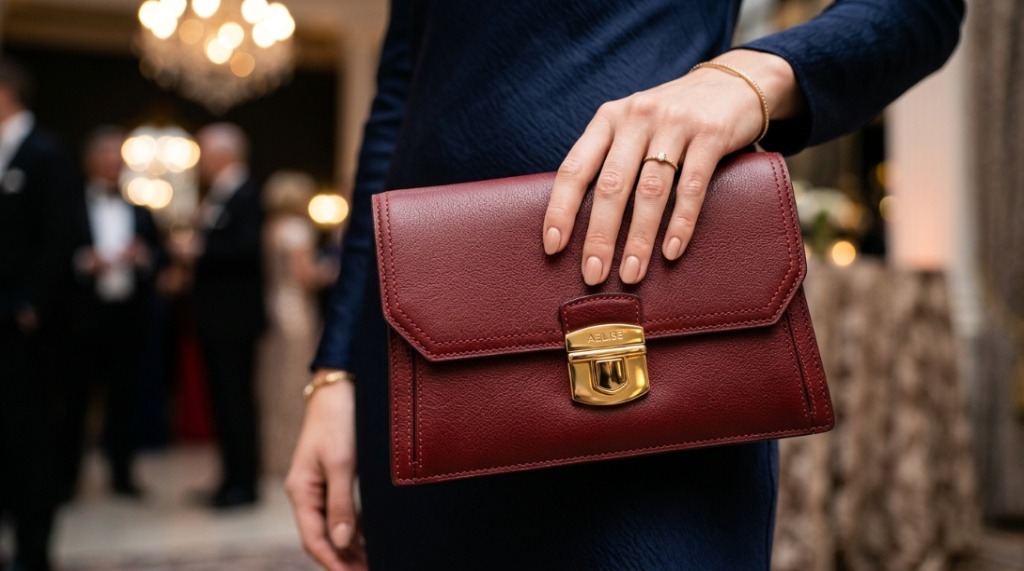
Investing in a designer clutch makes financial and emotional sense when you’ll carry it frequently, when resale value matters to you, and when the tactile quality of premium materials genuinely enhances your experience.
A designer clutch earns its price in these scenarios:
- High-frequency use: You attend 15+ events annually where you’ll carry a clutch. A $1,200 piece used 15 times per year for 10 years costs $8 per carry. That’s excellent value.
- Career signaling: Certain professions and social environments respond to recognizable luxury accessories. If your context rewards visible quality investment, designer pieces deliver professional dividends.
- Resale strategy: You plan to rotate accessories every 3–5 years. Buying from brands with strong resale markets (Chanel, Hermès, Bottega Veneta) means you’ll recover 50–80% of your investment when upgrading.
- Material sensitivity: You genuinely notice and appreciate the feel of full-grain leather, the click of precision hardware, and the weight distribution of expert construction. For sensory-oriented people, this experience is worth paying for.
- Milestone marking: A designer clutch commemorating a promotion, birthday, or achievement carries emotional weight that enhances every carry. This psychological value is real and valid.
Conversely, designer spending doesn’t make sense if you carry a clutch twice yearly, never resells accessories, or wouldn’t notice material quality differences in a blind test. Self-honesty here saves thousands.
When Is an Affordable Clutch Bag the Smarter Choice?
An affordable clutch is the smarter choice when you’re testing a new style direction, attending infrequent events, working within a defined budget, or prioritizing variety over single-item luxury.
Financial intelligence isn’t always about buying the cheapest option — it’s about allocating resources where they create the most satisfaction. Affordable clutches win in these situations:
- Style experimentation: Trying a bold color, unusual texture, or trendy shape? A $100 clutch lets you experiment without $1,000 consequences if the trend doesn’t suit you.
- Infrequent formal events: If you attend 2–4 evening events annually, even a $50 clutch costs a reasonable $12–$25 per carry over its lifespan. Designer pricing cannot be justified at this frequency for most budgets.
- Wardrobe variety priority: Three well-chosen $150 clutches covering different occasions deliver more styling versatility than one $450 clutch. If variety enhances your confidence more than singular luxury, affordable buying wins.
- Budget-conscious periods: Student years, career transitions, or saving-priority phases. No accessory should create financial stress. An affordable clutch worn with confidence outperforms a designer piece purchased with guilt.
- High-risk events: Outdoor weddings, beach parties, crowded concerts — events where damage risk is high. Carrying an $80 clutch in risky environments removes the anxiety that protects a $1,500 investment from being compromised.
The mid-range market ($80–$250) has improved dramatically. Brands like Cuyana, Madewell, and & Other Stories now deliver genuine leather clutches with clean construction at prices that undercut designer equivalents by 70–85%. The quality gap narrowed significantly in the past five years.
How Do You Compare Quality Between Price Tiers?
Compare quality by physically examining five specific elements: leather grain consistency, hardware weight, stitching evenness, edge finishing, and closure mechanism precision.
Skip the price tag and use your senses. Here’s a quality comparison guide you can apply in any store:
- Leather test: Press your thumbnail gently into the surface. Full-grain leather shows a temporary lighter mark that fades (sign of natural, uncoated hide). Bonded leather or PU shows no marks or leaves a permanent dent.
- Hardware test: Tap the clasp against a hard surface. Quality metal produces a clear ring. Cheap plated hardware makes a dull thud. Also,o check: does the closure align perfectly? Misalignment indicates cost-cutting.
- Stitch test: Count stitches per inch along a seam. A higher count (8–10 per inch) indicates precision. Lower count (4–5 per inch) indicates speed-prioritized manufacturing. Consistency matters more than count — uneven spacing signals poor quality at any price.
- Edge test: Run your finger along leather edges. Smooth, slightly rounded, and evenly colored edges mean careful finishing. Rough, uneven, or cracking edges mean corners were cut — literally.
- Symmetry test: Fold the clutch mentally along its center. Does everything mirror perfectly? Asymmetric stitching, uneven flap placement, or off-center hardware reveal construction shortcuts.
Using these physical tests, you’ll find exceptional quality at $150 and disappointments at $1,000. Price tier indicates probability of quality, not guarantee. Always verify with your own assessment.
Does a Designer Clutch Actually Last Longer Than an Affordable One?
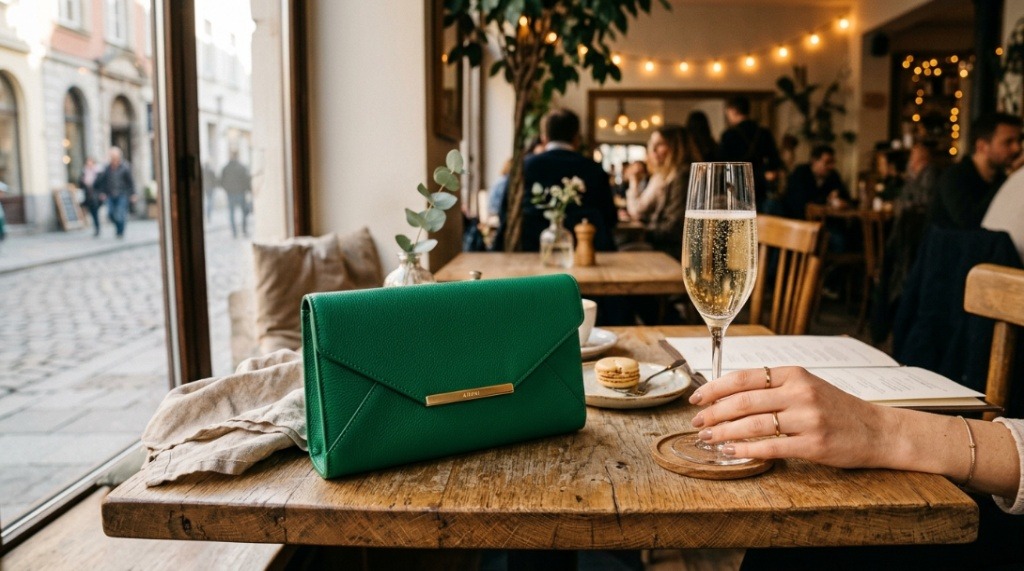
Designer clutches generally last longer due to superior material sourcing and construction techniques — but the gap narrows significantly when comparing quality-focused, affordable brands rather than fast-fashion alternatives.
Longevity comparison under typical use (10–20 carries per year):
- Fast-fashion clutch ($20–$50): 1–3 years before visible deterioration. PU peeling, hardware tarnishing, and shape loss.
- Quality affordable clutch ($100–$250): 5–8 years with proper care. Genuine leather develops character rather than deteriorating. Hardware maintains its finish.
- Designer clutch ($500–$2,000): 10–20+ years. Full-grain leather ages beautifully. Premium hardware resists corrosion. Most heritage brands offer repair services that extend life indefinitely.
The critical variable: care habits. A quality, affordable clutch stored properly (stuffed, dust-bagged, conditioned annually) will outlast a designer clutch that’s thrown into drawers, exposed to sunlight, and never maintained. Ownership behavior often matters more than manufacturing origin.
Additionally, designer brands like Hermès, Louis Vuitton, and Chanel offer in-house repair services — reconditioning leather, replacing hardware, and restoring structure. This lifetime maintenance option doesn’t exist for affordable brands and effectively makes designer pieces renewable.
What About the Resale Value Argument?
Designer clutch bags from top-tier brands retain 40–80% of retail value on resale platforms, making them partially recoverable investments — while affordable clutches have essentially zero resale value.
Resale value data from authenticated luxury resale platforms (2024):
- Chanel clutches: Average 70–85% retail value retention. Limited editions can appreciate above retail.
- Hermès clutches: 80–120% retention. Certain models consistently sell above the original price.
- Bottega Veneta: 50–65% retention. Strong demand for classic intrecciato styles.
- Saint Laurent: 45–60% retention. Classic styles hold better than trendy releases.
- Mid-range designer ($300–$600): 25–40% retention. Sufficient to fund partial upgrades.
- Affordable brands: 0–15% retention. Essentially no secondary market demand.
For financially strategic buyers, this creates a “rotation strategy”: buy a designer clutch, carry it for 3–5 years, resell at 50–70% of the price paid, and use proceeds toward your next purchase. Your net cost of ownership becomes $300–$500 for years of carrying a $1,500 bag — comparable to buying and discarding three affordable clutches across the same period.
However, this only works with brands that have proven resale demand. A $800 clutch from a lesser-known designer without resale market presence may retain zero value — delivering the worst of both worlds (high cost, no recovery).
When building a versatile accessory collection, balancing your budget across different bag styles is key. While a clutch is perfect for evening events, you might want to allocate a larger portion of your budget to a daily workhorse. If you want to expand your collection with practical everyday options, you can find stunning, high-quality designer tote bags for women without overpaying by knowing which materials and mid-tier luxury brands offer the best value.
How Should Your Budget and Lifestyle Determine Your Choice?
Let your actual event frequency, financial comfort zone, and style stability — not aspirations or social pressure — determine whether designer or affordable clutches serve your life better.
Practical decision framework:
- If you carry a clutch 20+ times per year and your financial position allows: one quality designer clutch offers the best long-term value through durability, repair options, and resale recovery.
- If you carry a clutch 5–15 times per year on a moderate budget, get two quality, affordable clutches (one neutral, one even), providing versatility at reasonable cost-per-carry.
- If you carry a clutch under 5 times per year: spend under $100 per piece. Your cost-per-carry math cannot justify luxury pricing at this frequency regardless of budget.
- If your style is still evolving: affordable clutches let you experiment freely. Discover your preferences at $100 before committing $1,000.
- If your style is established and stable: designer investment makes sense because you know with certainty what you’ll still love in five years.
The most financially intelligent approach isn’t choosing one tier permanently. It’s using different tiers for different purposes: affordable for trend experiments and high-risk occasions, designer for cornerstone pieces you’ve proven you’ll carry repeatedly.
Conclusion
The choice between designer and affordable clutch bags isn’t binary — and it shouldn’t be emotional. Both tiers offer genuine value when deployed strategically. Designer clutches deliver superior materials, lasting construction, and recoverable investment through resale. Affordable clutches deliver variety, experimentation freedom, and rational spending aligned with actual use frequency.
The smartest buyers use both. They invest in one designer clutch as their foundation piece — the one they reach for three times a month without thinking — and supplement with affordable options for trend-testing, risky events, and occasional variety. Drop the guilt around either choice. A $100 clutch carried with confidence outperforms a $2,000 clutch carried with buyer’s remorse every single time. Know your frequency, know your budget, know your style stability, and choose accordingly.
Frequently Asked Questions
Can people really tell the difference between designer and affordable clutch bags?
At normal social distance (3+ feet), most people cannot distinguish between a well-chosen affordable clutch and a designer equivalent — especially in evening settings with dim lighting. The differences are primarily tactile (leather feel, hardware weight) and visible only upon close physical inspection. Fashion-industry professionals may recognize specific designer silhouettes, but average observers rarely notice.
What affordable clubagba,g brands come closest to designer quality?
Cuyana, Polène, & Other Stories, Massimo Dutti, and Italic consistently deliver craftsmanship closest to designer standards at 70–85% less cost. These brands use genuine leather, quality hardware, and clean construction while avoiding the marketing overhead that inflates luxury pricing. Direct-to-consumer models enable better materials at lower retail prices.
Is it worth buying a used designer clutch instead of a new affordable one?
Often yes. A pre-owned designer clutch at $300–$500 (50–70% off retail) typically offers superior materials, construction, and resale value compared to a new affordable clutch at the same price. Authenticated platforms like The RealReal, Vestiaire Collective, and Rebag provide quality guarantees. The key risk is condition — always review detailed photos and authentication certificates before purchasing.
How many clutch bags does the average woman need?
Most style experts recommend three: one versatile neutral for regular events, one formal evening piece for black-tie occasions, and one personality-driven statement clutch for celebrations. This three-piece approach covers 95% of scenarios. Whether these come from designer or affordable tiers depends entirely on individual budget and use frequency for each occasion type.
Do designer clutch bags go on sale?
Some do, some don’t. Brands like Saint Laurent, Givenchy, and Jimmy Choo participate in seasonal sales (30–50% off at department stores). Brands like Chanel, Hermès, and Louis Vuitton never discount — instead, they raise prices annually. Outlets (Gucci Outlet, Prada Space) offer reduced pricing on previous-season inventory, though selection is limited and some outlet-exclusive products are lower quality than mainline.
What’s the best first designer clutch purchase for a beginner?
A Saint Laurent envelope clutch in smooth black leather offers the best entry point — recognizable quality, timeless shape, versatile styling, and strong resale value (50–60% retention). Priced between $1,000–$1,500, it’s accessible within the luxury tier while delivering unmistakable craftsmanship that justifies the investment through years of reliable use.
Should I save up for a designer clutch or buy affordable now?
If you have events coming within the next month, buy affordable now and enjoy them immediately. If your next formal event is 6+ months away, saving toward a designer piece you’ve researched thoroughly often delivers more lasting satisfaction than an impulse, affordable purchase. Never force financial strain for an accessory — confidence comes from comfort, not credit card debt.