I spent $2,400 on new light-grey carpet last year — and within 72 hours, my Border Collie had stamped a trail of muddy paw prints from the back door straight to the couch during a rainstorm I did not hear start. That single moment of inattention cost me a professional carpet cleaning bill and a week of frustration. If you own a dog and live anywhere with rain, snow, or dirt, muddy paw prints are not a possibility — they are a certainty unless you build a system to prevent them. A dog paw cleaner routine combined with strategic entry management stops mud at the door before it reaches your floors, furniture, and sanity. The goal is not to restrict your dog’s outdoor freedom — it is to create a 60-second transition zone between outside mess and inside clean that becomes automatic for both you and your dog. This guide covers the complete system: entry station setup, cleaning tools, training protocols, and floor protection strategies that keep your home spotless without limiting your dog’s life. Learning to clean dog paws at home efficiently is the single highest-impact habit for any dog owner who values both their pet’s freedom and their home’s appearance.
Why Do Muddy Paw Prints Cause So Much Damage to Floors?
Muddy paw prints damage floors because wet mud contains abrasive particles (sand, grit, small stones) that grind into floor surfaces under the pressure of a walking dog’s weight — and the organic matter in mud stains porous materials like grout, carpet fibers, and unsealed wood permanently if not removed quickly.
The damage goes beyond visible prints:
- Hardwood floors: Grit in mud acts like sandpaper under paw pads, scratching finish coats with every step. Repeated exposure dulls the finish permanently.
- Carpet: Mud particles sink into carpet fibers and bond with the backing. Once dried, vacuuming removes surface dirt but leaves deep staining that requires professional extraction.
- Tile and grout: Mud penetrates porous grout lines and stains them brown. Sealed grout resists better but still discolors over time without prompt cleaning.
- Laminate: Standing moisture from wet paw prints seeps into seams between planks, causing swelling and edge warping that is irreversible.
- Rugs: Natural fiber rugs (wool, cotton, jute) absorb moisture and develop mold or mildew if not dried quickly.
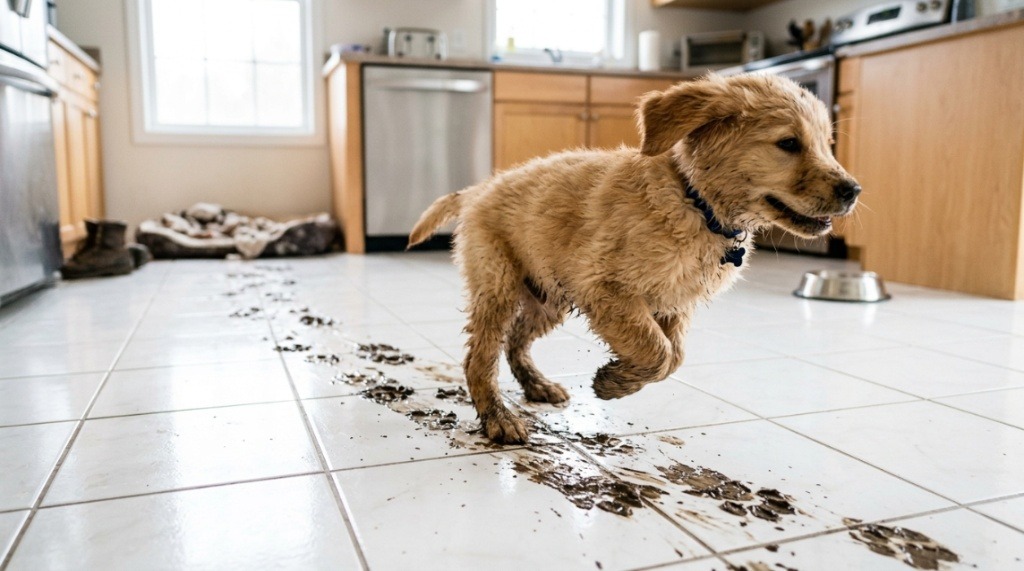
A single muddy walk can deposit 50–100 individual paw prints between your door and wherever your dog settles. Each print contains enough abrasive material to cause micro-damage. Over months and years, this accumulates into visible wear patterns, permanent staining, and premature floor replacement needs.
What Is the Best Entry System to Stop Mud at the Door?
The best entry system uses a three-zone approach: an outdoor scraper mat, a transition area with paw cleaning supplies, and an indoor absorbent mat — creating a layered barrier that removes mud progressively before your dog reaches living spaces.
Outdoor scraper mat (outside the door)
- Heavy-duty rubber or coir mat with aggressive texture
- Removes bulk mud and debris as the dog walks across it
- Handles the first 60–70% of mud removal passively
- Choose a mat large enough for your dog to take 2–3 steps on
Transition/cleaning area (just inside the door)
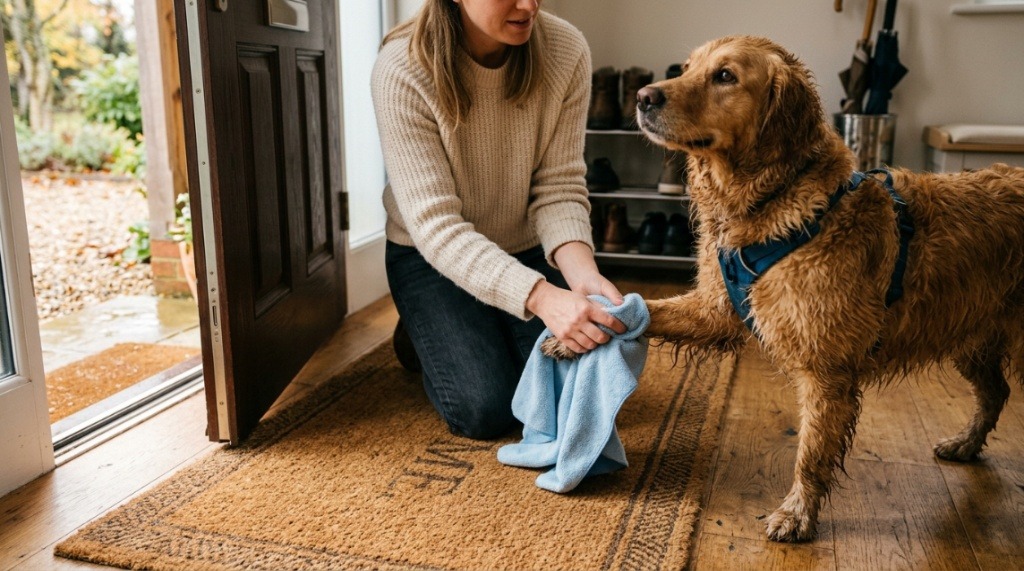
- Waterproof mat or tray to contain drips
- Paw cleaner cup pre-filled with water
- Dedicated microfiber towel hanging within reach
- Treat jar for positive reinforcement
- This is where active paw cleaning happens — 60 seconds
Indoor absorbent runner (leading away from the door)
- Washable absorbent runner mat (3–6 feet long)
- Catches any residual moisture missed during cleaning
- Protects the first section of flooring from damp paws
- Machine-washable for easy maintenance
This layered approach means even if you miss a paw or your dog slips past you, the damage is contained to washable, replaceable surfaces rather than your permanent flooring.
Which Dog Paw Cleaner Works Best for a Door-Side Routine?
A medium-to-large silicone bristle paw washer cup kept pre-filled by the door works best for door-side routines because it requires zero prep time, cleans all four paws in under 60 seconds, and contains all mess within the cup rather than spreading it.
Door-side paw cleaner requirements:
- Always ready: Pre-filled with water so there is no delay when you walk in
- Self-contained: All mud stays inside the cup, not on your floor or hands
- Quick: Insert-twist-remove takes 10–15 seconds per paw
- Easy to empty: Pour dirty water down a nearby drain or into a designated bucket
- Durable: Silicone construction survives daily use for years without degradation
Position the paw cleaner on your transition mat within arm’s reach of where you stand when your dog enters. Keep the towel hanging on a hook at the same height — no bending or searching. The entire station should allow you to clean all four paws without moving your feet. This ergonomic setup makes the routine effortless enough that you actually do it every single time, even when tired or rushed.
For choosing the right paw cleaner size and style for your specific dog breed, the best dog paw cleaner options provide detailed comparisons that match tool size to breed and paw dimensions.
How Do You Train Your Dog to Wait for Paw Cleaning at the Door?
The fencing is secure and resistant to dogs.
Step-by-step training protocol:
1: Door threshold wait</strong>
- Before entering, ask your dog to “wait” or “sit” at the door
- Reward immediately for any pause — even 1 second counts initially
- Gradually extend wait duration to 10–15 seconds
- Practice 2–3 times per day (every walk is a training opportunity)
2: Add paw handling</strong>
- During the wait, touch one paw briefly, reward
- Progress to lifting one paw, reward
- Introduce the paw cleaner cup (let them sniff it, reward)
- Brief 2-second paw dip, heavy reward
3+: Full routine</strong>
- Complete all four paws with rewards between each
- Gradually reduce to one reward after all paws are done
- Add the towel dry step
- Release with an enthusiastic “okay!” to enter the house
The key insight: your dog learns that the fastest path to getting inside (where food, comfort, and family are) goes through the paw cleaning station. Cooperation becomes self-reinforcing because it leads to what they want — entry. Fighting the process delays entry. Dogs figure this out quickly when the routine is consistent.
What Floor Protection Strategies Work When Paw Cleaning Is Not Possible?
When immediate paw cleaning is not possible (dog slips past, emergency entry, multiple dogs at once), washable runner mats, strategic area rug placement, and floor sealant treatments provide backup protection that contains damage to cleanable surfaces.
Backup protection layers:
- Washable runner mats: Place machine-washable runners along your dog’s most common paths (door to water bowl, door to bed, door to couch). These catch 90% of tracked mud on a surface you can throw in the washing machine weekly.
- Area rugs over high-traffic zones: Inexpensive, washable area rugs protect permanent flooring in spots where your dog always walks. Replace annually rather than refinishing hardwood.
- Floor sealant: Polyurethane sealant on hardwood, grout sealer on tile, and scotchgard on carpet create moisture barriers that prevent mud from bonding permanently. Reapply annually.
- Dog door mat training: Train your dog to go directly to a specific mat upon entry. This concentrates any missed mud on one washable surface rather than spreading it throughout the house.
The philosophy: assume paw cleaning will occasionally fail and build redundancy into your floor protection. A single point of failure (only the paw cleaner) means one missed session equals muddy floors. Multiple layers mean even a complete miss results in contained, cleanable mess.
How Do You Handle Multiple Dogs Coming Inside at Once?
For multiple dogs, train a sequential entry order where each dog waits their turn on the outdoor mat while you clean one at a time — or use a large shallow basin that all dogs step through simultaneously for bulk mud removal before individual paw drying.
Multi-dog strategies:
Sequential entry (best for trained dogs)
- Teach each dog their entry order (most patient dog last)
- First dog enters, gets cleaned, released inside
- Second dog enters, repeat
- Works well for 2–3 dogs; becomes slow with 4+
Basin walk-through (best for multiple dogs)
- Place a large shallow basin (boot tray or concrete mixing tub) filled with 2 inches of water at the entry
- All dogs walk through it upon entry — removes bulk mud passively
- Follow with a quick towel dry on the absorbent runner
- Faster than individual cup cleaning for 3+ dogs
Outdoor rinse station (best for very muddy conditions)
- Garden hose with a gentle spray nozzle at the entry point
- Quick rinse of all paws before any dog enters
- Towel dry on the transition mat
- Seasonal option (not practical in freezing weather)
What Cleaning Products Remove Dried Muddy Paw Prints From Floors?
For dried mud on hard floors, a damp microfiber mop lifts residue without scratching. For carpet, let mud dry completely, vacuum the dried chunks, then spot-treat remaining stains with an enzyme cleaner — never scrub wet mud into carpet fibers.
Floor-specific removal methods:
- Hardwood: Damp (not wet) microfiber mop with pH-neutral wood floor cleaner. Avoid excess water that can seep between boards. For stubborn spots, a soft-bristle brush with cleaner, then immediate dry-mopping.
- Tile: Standard mopping removes surface mud. For grout stains, apply baking soda paste, let sit 10 minutes, scrub with a grout brush, rinse. Seal grout annually to prevent future staining.
- Carpet: Critical rule — let mud dry completely before cleaning. Wet scrubbing pushes mud deeper into fibers. Once dry, vacuum thoroughly to remove loose particles. Treat remaining stains with enzyme-based pet stain remover. Blot, never rub.
- Laminate: Damp microfiber cloth only. Excess water damages laminate. For dried mud, gently scrape with a plastic scraper before damp wiping. Never use abrasive cleaners.
- Vinyl/LVP: Most forgiving surface. Standard mopping with any floor cleaner works. Mud rarely stains vinyl permanently.
How Do Seasonal Changes Affect Your Paw Cleaning Routine?
Each season brings different paw contaminants — spring mud, summer allergens, fall leaf mold, and winter salt/ice melt — requiring routine adjustments in water temperature, cleaning frequency, and post-cleaning paw care to match seasonal challenges.
Seasonal adjustments:
| Season | Primary Contaminant | Cleaning Adjustment | Extra Care Needed |
|---|---|---|---|
| Spring | Heavy mud, pollen | Full paw wash every walk, lukewarm water | Check between pads for embedded debris |
| Summer | Dust, hot pavement residue, allergens | Quick rinse or wipe, cool water | Check for burns on pads from hot surfaces |
| Fall | Wet leaves, mold spores, mud | Full paw wash, check for leaf debris between toes | Dry thoroughly — fall dampness promotes yeast |
| Winter | Road salt, ice melt chemicals, snow | Warm water wash mandatory, dissolve all salt | Apply paw balm after washing to prevent cracking |
Winter demands the most rigorous routine because road salt and chemical ice melts cause actual tissue damage to paw pads — not just a mess. A warm water wash after every winter walk is non-negotiable for paw health, regardless of whether your floors need protection.
Conclusion
Stopping muddy paw prints from ruining your home requires a system, not just a single tool. Build a three-zone entry station (outdoor mat, cleaning area, indoor runner), keep your dog paw cleaner pre-filled and ready, train a consistent door-wait behavior, and layer backup floor protection for the inevitable missed sessions. The investment is minimal — under $50 for a complete entry station setup — and the return is permanent floor protection plus a calmer, more structured transition from outdoor adventures to indoor living.
Start this weekend. Set up your entry station, practice the door-wait with treats for three days, and time your paw cleaning routine. Most owners achieve a consistent sub-60-second routine within a week. Your floors, your furniture, and your stress levels will thank you immediately.
What is your biggest challenge with muddy paw prints — training your dog to wait, finding the right cleaning tool, or protecting specific floor types? Share below and let’s solve it together.
Frequently Asked Questions
How do I stop my dog from running past me before I can clean their paws?
Install a baby gate or exercise pen at your entry point that creates a physical barrier. Your dog enters the contained transition area but cannot access the rest of the house until you release them. This removes the training challenge entirely while you work on building a voluntary wait behavior through positive reinforcement over time.
Do paw cleaning doormats actually work?
Paw cleaning doormats (chenille or microfiber mats with deep pile) remove surface moisture and light dirt effectively but cannot clean between paw pads or remove heavy mud. They work as Zone 3 backup — catching residual dampness after active cleaning — but should not be your only line of defense against serious mud.
How often should I wash my dog’s paw cleaning towels?
Wash paw cleaning towels every 3–4 uses or weekly, whichever comes first. Damp towels used on dirty paws breed bacteria quickly. Keep 3–4 towels in rotation so a clean one is always available while others are in the laundry. Use hot water and unscented detergent to sanitize without leaving fragrance residue that might irritate paw skin.
Can I use a boot tray as a paw cleaning station?
Yes — a large boot tray works excellently as a containment area for your paw cleaning station. Place your paw washer cup, towel, and treats on the tray. Any drips or splashes stay contained on the tray rather than your floor. Choose a tray large enough for your dog to stand on with all four paws for maximum mess containment.
Will muddy paw prints stain my hardwood floors permanently?
Muddy paw prints will not permanently stain properly sealed hardwood floors if cleaned within a few hours. However, repeated wet contact can dull the finish over time, and mud left overnight on unsealed or worn-finish areas can penetrate the wood grain and leave permanent marks. Maintain your floor’s sealant coat and clean prints promptly to prevent any lasting damage.
Is it okay to let mud dry on my dog’s paws before cleaning?
Letting mud dry on paws before cleaning is acceptable and sometimes easier — dried mud brushes off more cleanly than wet mud. However, do not let your dog walk through the house with wet muddy paws intending to clean later. Contain them in the entry area, let paws air-dry for 5–10 minutes, then brush off dried mud and follow with a quick wipe. This works well for dogs who resist wet paw washing.
How do I protect my couch and bed from muddy paws?
Use washable furniture covers on your dog’s favorite spots, place a dedicated dog blanket on the couch that you can remove and wash, and train an “up” command that only works after paw cleaning is complete. Waterproof mattress protectors under your bedding prevent mud from reaching the mattress if your dog sleeps on the bed. Prevention at the door remains the most effective strategy.